
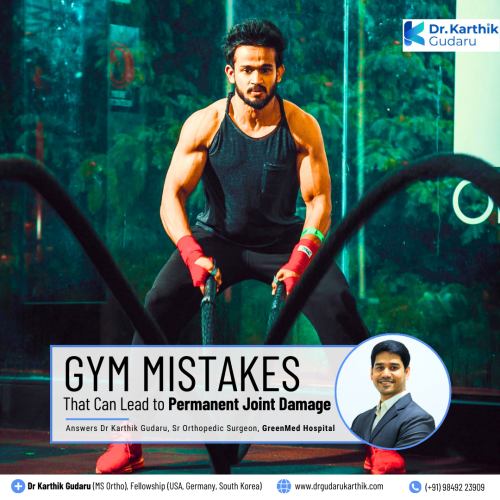
Walk into any gym and you’ll see dedication everywhere—people pushing their limits, chasing strength, endurance, and better health. Exercise is undeniably one of the best investments you can make for your body.
Yet, hidden within this positive habit is a mistake so common that many don’t even recognise it until pain, stiffness, or injury becomes a constant companion. This single error, repeated over time, can quietly lead to permanent joint damage, affecting not just workouts but everyday life.
The mistake is lifting weights with poor form—especially under heavy load.
It may seem harmless at first. You complete the set, feel tired, maybe even proud of pushing heavier than before. But joints remember what muscles forget, and they pay the price for every misaligned movement, says Dr Karthik Gudaru, who is one of the top orthopaedic surgeons in Hyderabad and one of the best joint replacement surgeons in India.
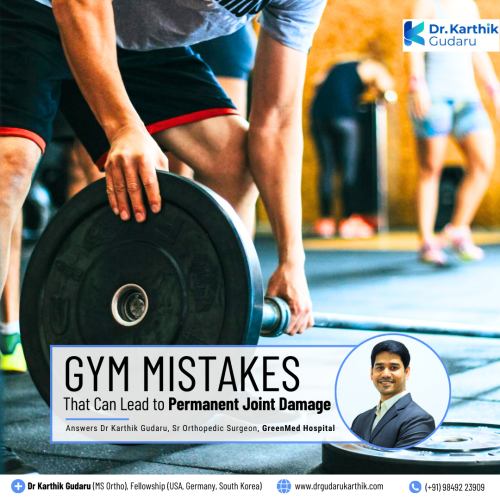
How a Gym Mistake Can Damage Your Joints?
Joints are complex structures. They are not designed to absorb force the way muscles are. Muscles contract and relax, tendons transmit force, but joints rely on precise alignment to distribute load safely across cartilage, ligaments, and surrounding tissues.
When exercise form is incorrect—rounded backs during deadlifts, knees collapsing inward during squats, locked elbows during presses, or jerky movements during lifts—the force that should be shared by muscles is redirected to the joints. Over time, this repeated stress leads to microtrauma. While a single workout won’t destroy a joint, months or years of improper loading can cause irreversible damage.
Unlike muscles, which heal relatively quickly, joint cartilage has a very limited blood supply. Once it begins to wear down, recovery is slow—and in many cases, incomplete.
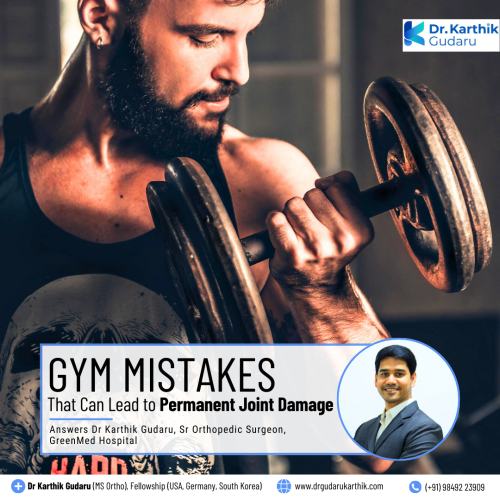
Why Is Poor Form More Dangerous Than Heavy Weights?
Many people assume that heavy weights alone are the problem. In reality, poor form with moderate weights is often more damaging than lifting heavy with correct technique.
Incorrect form alters joint mechanics. For example, when squatting with knees drifting far forward or caving inward, the knee joint absorbs excessive shear force. During shoulder exercises performed with flared elbows or uncontrolled momentum, the rotator cuff is strained repeatedly. In deadlifts done with a rounded spine, spinal discs are compressed unevenly, accelerating disc degeneration.
These stresses don’t always cause immediate pain. Instead, they create a slow-burning injury that surfaces later as chronic discomfort, reduced mobility, or sudden acute injury during an otherwise routine movement.
The Silent Progression of Joint Damage
One of the most dangerous aspects of joint damage is how quietly it develops. The early signs are subtle and easy to dismiss: stiffness in the morning, clicking sounds, mild discomfort that disappears after warming up. Many gym-goers ignore these warnings and continue training the same way.
As damage progresses, inflammation becomes more frequent. Tendons may start compensating for unstable joints, leading to conditions such as tendinitis or bursitis. Cartilage begins to thin, reducing shock absorption. Eventually, the joint becomes vulnerable to osteoarthritis, labral tears, or ligament injuries.
At this stage, even daily activities like climbing stairs, lifting groceries, or sitting for long periods can trigger pain. What began as a fitness routine meant to improve health now limits it.
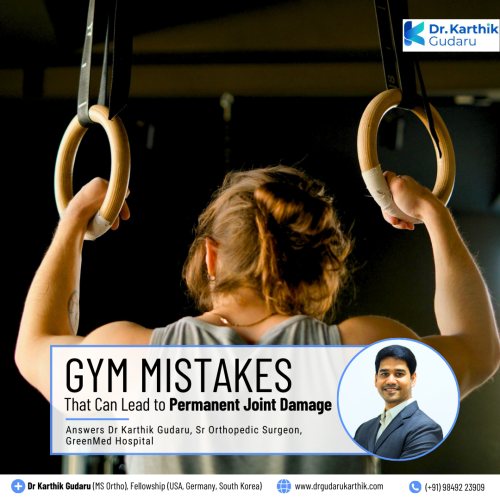
Common Exercises Where This Mistake Happens
Compound movements are particularly risky when performed incorrectly because they involve multiple joints at once. Squats, deadlifts, bench presses, overhead presses, lunges, and pull-ups are highly effective exercises—but only when done with control and alignment.
Fatigue plays a major role. As muscles tire, form break down. Many people push through poor technique to complete “one last rep,” unaware that this is when joints are most exposed. Ego lifting—choosing weight based on appearance rather than ability—only increases the risk.
Even machine-based workouts are not foolproof. Poor seat adjustment, incorrect range of motion, or locking joints at the end of a movement can still cause damage over time.
Why Rest and Recovery Matter for Joint Health?
Another part of this mistake is neglecting recovery. Joints need time to adapt to load, just like muscles do. Training the same joints intensely every day without adequate rest accelerates wear and tear.
Sleep deprivation, poor nutrition, and inadequate hydration further reduce the body’s ability to repair connective tissue. Without recovery, minor joint irritation turns into chronic inflammation, making permanent damage far more likely.
How to Train Without Sacrificing Your Joints?
Preventing joint damage doesn’t mean avoiding the gym—it means training intelligently. Proper technique should always come before weight progression. Slower, controlled movements protect joints far more than fast, uncontrolled repetitions.
Learning correct form from a qualified trainer, using mirrors sparingly for alignment checks, and recording workouts for self-review can make a significant difference. Listening to pain signals—especially sharp or persistent joint pain—is essential. Pain is not weakness; it is information.
Warm-ups that include mobility work and activation exercises prepare joints for load, while cooldowns and stretching help maintain long-term joint health. Most importantly, respecting rest days allows connective tissue the time it needs to recover and strengthen.
When Should You See an Orthopaedic Surgeon?
Not every gym-related ache requires medical intervention, but certain warning signs should never be ignored. If joint pain persists despite rest, proper form correction, and reduced training intensity, it may indicate deeper structural damage. Ongoing pain lasting more than two to three weeks, especially if it worsens with movement or interrupts sleep, is a strong signal to seek professional evaluation.
You should consult an orthopaedic surgeon if you experience joint swelling that does not subside, repeated joint instability, locking or catching sensations, or a noticeable reduction in range of motion. Sharp pain during specific movements, weakness that limits daily activities, or pain following a sudden injury—such as a fall or incorrect heavy lift—also warrants attention.
Early orthopaedic assessment is especially important because many joint conditions are progressive. Timely diagnosis can prevent minor cartilage wear, ligament strain, or tendon injury from evolving into permanent joint damage or arthritis. Seeing a specialist is not about ending your fitness journey—it is about protecting it, ensuring you can continue to move, train, and live pain-free in the long run.
The gym is a powerful tool for health, but it can also become a source of long-term injury when approached carelessly. Poor form under load is the one mistake that quietly destroys joints, often without immediate warning. While muscles may grow stronger, joints may deteriorate in the background, leading to permanent limitations.
True fitness is not about lifting the heaviest weight today—it’s about moving well for decades to come. When you prioritize form, control, and recovery, you protect your joints and ensure that your fitness journey enhances your life rather than restricts it.

Dr Karthik Gudaru, MS Orthopaedics, MBBS, Fellowship in Knee and Hip Arthroplasty (USA), Fellowship in Computer-Assisted Navigation Joint Replacement Surgery (Germany), is one of Hyderabad’s leading orthopaedic surgeons with an outstanding reputation for precision, innovation, and excellence in joint replacement and orthopaedic care. Widely recognised as the best knee replacement specialist in Hyderabad, he brings a deep commitment to patient-centred care and cutting-edge surgical techniques.
Dr Karthik Gudaru is currently the Senior Orthopaedic and Joint Replacement Specialist, Department of Orthopaedics at GreenMed Hospital, Srinagar Colony, Hyderabad and Assistant Professor and Consultant Orthopaedic at BIRRD Hospital (Balaji Institute of Surgery, Research and Rehabilitation for the Disabled), Tirupati.
Dr Karthik Gudaru’s Treatment Specialisation are –
Knee Joint Treatments (Including Total Knee Replacement Surgery)
Shoulder Joint Treatments (Including Total Shoulder Replacement Surgery)
Hip Joint Treatments (Including Total Hip Replacement Surgery)
Elbow Joint Treatments (Including Total Elbow Arthroscopy)
Computer-Assisted Knee Replacement Surgery
Stem Cell Therapy for key orthopaedic treatments