
Key Summary
- Early detection enables preparation: Prenatal scans help identify clubfoot in advance, allowing families to plan specialist care and informed delivery arrangements.
- Treatment is effective and timely: Post-birth correction methods like the Ponseti technique offer safe, structured, and highly successful outcomes when started early.
- Support eases the journey: Medical guidance, emotional readiness, and a strong support system help parents navigate the diagnosis with confidence and clarity.
This Article is Medically Reviewed by Dr Karthik Gudaru, MS Orthopaedics, Fellowship in Computer-Assisted Navigation and Joint Replacement Surgery (Germany), HOD Orthopaedic Department, GreenMed Hospitals, Hyderabad
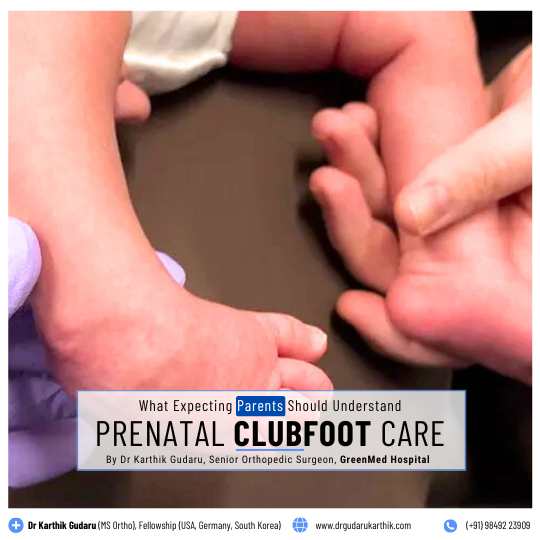
Pregnancy is a journey filled with anticipation, planning, and careful medical monitoring. Modern prenatal screening allows doctors to detect many congenital conditions early, giving families time to understand and prepare. One such condition is clubfoot, a developmental difference where a baby’s foot is positioned inward or downward due to the way bones, muscles, and tendons form during fetal growth.
While the diagnosis can feel worrying at first, clubfoot is highly treatable with timely medical care. Prenatal awareness helps parents move from uncertainty to preparedness, ensuring their child receives the right support from the very beginning, shares Dr Karthik Gudaru, HOD orthopaedic department at GreenMed Hospital, Hyderabad and a specialist pediatric orthopedic surgeon in Hyderabad and India.
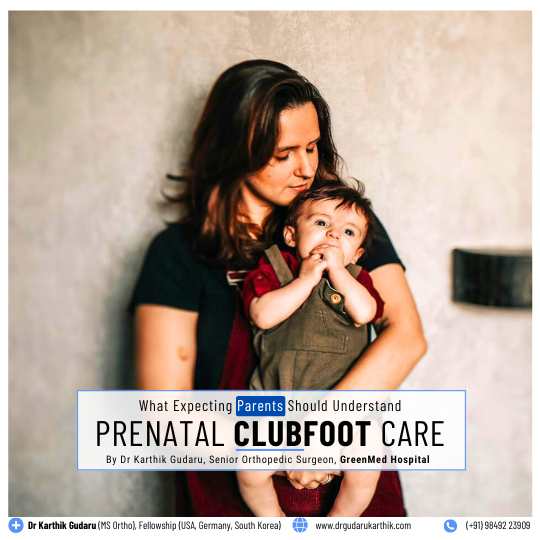
What Should Expecting Parents Do If Clubfoot Is Detected Before Birth?
When clubfoot is identified during pregnancy—most commonly in the second-trimester ultrasound—the focus shifts from fear to planning. Prenatal care does not typically involve correcting the condition before delivery. Instead, it centers on confirmation, medical guidance, delivery planning, and preparation for early treatment after birth.
Dr Karthik Gudaru says that, “Prenatal awareness transforms a moment of fear into a pathway of preparation—when clubfoot is detected early, parents gain the time, knowledge, and medical support needed to welcome their child with confidence, begin timely treatment, and move forward with reassurance that a healthy, active future is well within reach.”
Understanding the Clubfoot Diagnosis
Ultrasound imaging can reveal the typical inward twisting of the baby’s foot. While scans may not always determine severity with precision, they provide reliable early detection. Doctors may recommend a detailed fetal anomaly scan to confirm the finding and check whether the condition appears alone or alongside other developmental concerns. In most cases, clubfoot is isolated, meaning the baby is otherwise healthy.

Knowing the Causes and Clearing Misconceptions
Clubfoot develops during fetal growth due to differences in the formation of muscles, tendons, and bones. It is not caused by parental activity, diet, travel, or routine movement during pregnancy. Understanding this medical basis is important because many parents experience unnecessary guilt after diagnosis. Clear counselling helps families focus on solutions rather than self-blame.
Planning the Right Medical Support
Prenatal detection gives families time to choose a hospital equipped with pediatric orthopaedic services. Early specialist access ensures that evaluation begins soon after birth. Doctors may also arrange consultations before delivery so parents understand the treatment roadmap and expected timeline. This preparation prevents rushed decisions and improves confidence.
Preparing for Treatment After Birth
Clubfoot correction typically begins within the first few weeks of life, when a newborn’s bones and connective tissues are most flexible. The most widely used method is the Ponseti technique, a gentle, step-by-step process that gradually aligns the foot using a series of casts changed weekly. This approach is safe and highly effective.
In many cases, a minor procedure is performed to release a tight heel tendon. It is quick, low-risk, and usually done under local anaesthesia. After the correction phase, the baby wears a special brace for a prescribed period to maintain alignment and prevent relapse. With proper adherence, most children develop normal walking patterns.
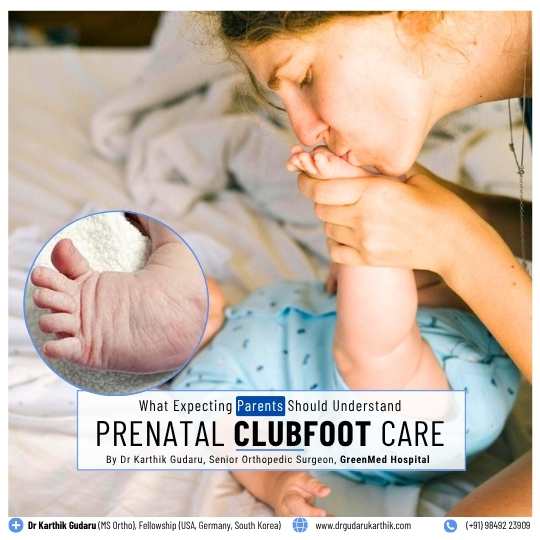
Emotional Readiness for Parents
A prenatal diagnosis often brings anxiety about the child’s future mobility and quality of life. Medical counselling helps parents understand that outcomes are overwhelmingly positive with early care. Most children treated for clubfoot grow up walking, running, and participating in everyday activities without limitations. Emotional preparedness allows families to approach treatment with confidence.
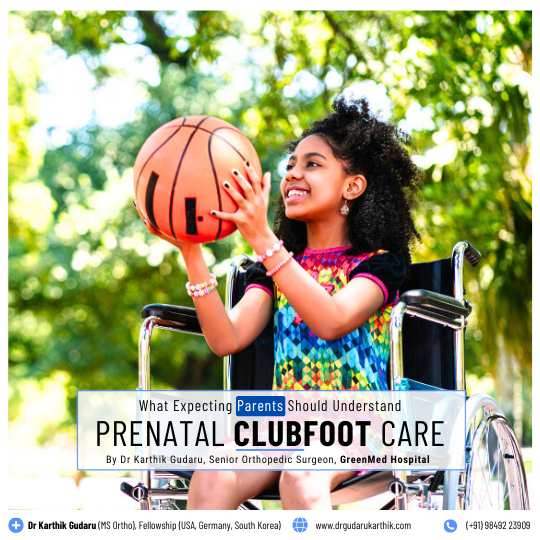
Building a Support System
Prenatal awareness gives families time to organise practical and emotional support. Scheduling appointments, arranging time for hospital visits, and connecting with other parents who have faced similar experiences can make the journey smoother. Support networks provide reassurance and practical guidance throughout treatment.
Prenatal Clubfoot Overview
| Stage | What Happens | Why It Matters |
|---|---|---|
| Prenatal Screening | Clubfoot is detected through routine ultrasound, usually in the second trimester | Early identification allows families to prepare emotionally and medically |
| Diagnosis Confirmation | Detailed fetal anomaly scans assess foot position and check for associated conditions | Ensures accurate understanding and rules out additional concerns |
| Parental Counseling | Doctors explain causes, treatment options, and expected outcomes | Reduces anxiety, clears misconceptions, and builds confidence |
| Delivery Planning | Selection of hospital with pediatric orthopedic facilities | Enables immediate specialist evaluation after birth |
| Early Post-Birth Assessment | Orthopedic evaluation soon after delivery | Confirms diagnosis and starts treatment planning without delay |
| Initial Treatment Phase | Gentle correction using the Ponseti technique with serial casting | Gradually aligns the foot safely and effectively |
| Minor Surgical Procedure (if needed) | Heel tendon release to improve flexibility | Enhances correction and supports proper foot positioning |
| Bracing & Maintenance | Use of corrective brace for prescribed duration | Prevents relapse and maintains alignment |
| Long-Term Outcome | Regular follow-ups and monitored development | Most children achieve normal mobility and active lifestyles |
Prenatal clubfoot care is ultimately about preparation, not panic. Early detection empowers families with knowledge, structured medical guidance, and a clear treatment pathway—turning a worrying diagnosis into a manageable and highly treatable condition.

Dr Karthik Gudaru, MS Orthopaedics, MBBS, Fellowship in Knee and Hip Arthroplasty (USA), Fellowship in Computer-Assisted Navigation Joint Replacement Surgery (Germany), is one of Hyderabad’s leading orthopaedic surgeons with an outstanding reputation for precision, innovation, and excellence in joint replacement and orthopaedic care. Widely recognised as the best knee replacement specialist in Hyderabad, he brings a deep commitment to patient-centred care and cutting-edge surgical techniques.
Dr Karthik Gudaru is currently the Senior Orthopaedic and Joint Replacement Specialist, Department of Orthopaedics at GreenMed Hospital, Srinagar Colony, Hyderabad and Assistant Professor and Consultant Orthopaedic at BIRRD Hospital (Balaji Institute of Surgery, Research and Rehabilitation for the Disabled), Tirupati.
Dr Karthik Gudaru’s Treatment Specialisation are –
Knee Joint Treatments (Including Total Knee Replacement Surgery)
Shoulder Joint Treatments (Including Total Shoulder Replacement Surgery)
Hip Joint Treatments (Including Total Hip Replacement Surgery)
Elbow Joint Treatments (Including Total Elbow Arthroscopy)
Computer-Assisted Knee Replacement Surgery
Stem Cell Therapy for key orthopaedic treatments