
From Non-Surgical Care to Advanced Surgical Options – By Dr Karthik Gudaru
Shoulder pain is a common complaint among people of all ages, especially those who perform repetitive overhead activities or sports. One of the most frequent causes of shoulder discomfort is a rotator cuff injury. The rotator cuff plays a vital role in stabilising and moving the shoulder joint, and any damage to it can severely affect daily activities, from lifting objects to simply combing hair. Understanding this injury and its treatment options—from conservative care to surgical repair—can help ensure the best recovery outcomes, says Dr Karthik Gudaru, a leading orthopedic surgeon and one of the most experienced orthopedic doctors for sports injury treatments, including rotator cuff surgeries in Hyderabad and India.
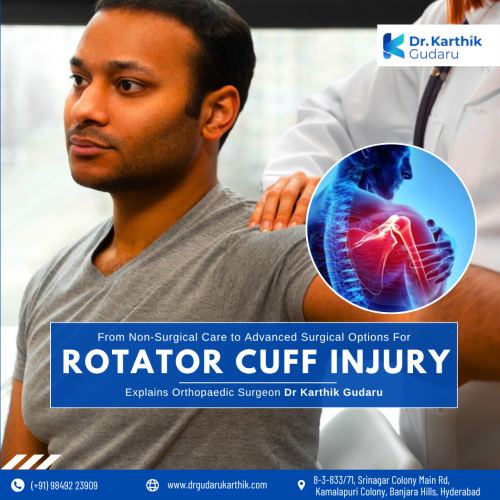
What is the Rotator Cuff?
The rotator cuff is a group of four muscles and their tendons that surround the shoulder joint—namely, the supraspinatus, infraspinatus, teres minor, and subscapularis. These muscles work together to stabilise the head of the upper arm bone (humerus) within the shallow shoulder socket. They also enable a wide range of shoulder movements such as lifting, rotating, and swinging the arm.
Healthy rotator cuff tendons glide smoothly within the joint, allowing flexible motion. However, when these tendons become irritated, torn, or inflamed, it leads to pain and limited mobility.
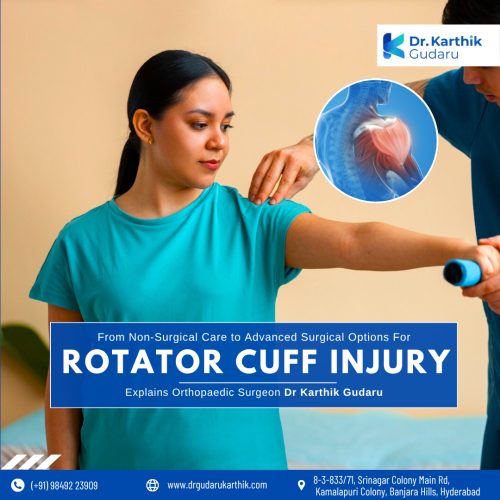
What is a Rotator Cuff Injury?
A rotator cuff injury occurs when one or more of these tendons or muscles become damaged. The injury can range from mild inflammation (tendinitis) to partial or complete tendon tears. It often results from repetitive stress, age-related wear and tear, or a sudden traumatic event such as falling on an outstretched arm. Common symptoms include:
- Shoulder pain that worsens at night or when lifting the arm
- Weakness in the shoulder
- Limited range of motion
- A crackling or popping sensation during movement
Rotator cuff injuries are more common in athletes (such as swimmers, tennis players, or baseball pitchers) and individuals with physically demanding jobs that involve repetitive overhead movements.
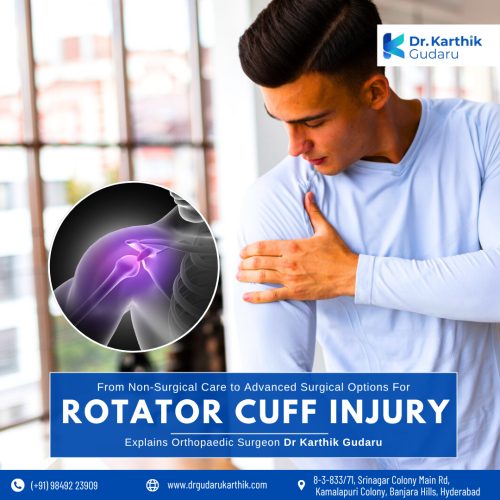
Treatment Approaches for Rotator Cuff Injuries
Treatment depends on the severity of the injury, the patient’s age, activity level, and overall health. Broadly, it falls into non-surgical and surgical approaches.
Non-Surgical Treatment: Most mild to moderate rotator cuff injuries can heal with conservative care. The primary goals are to reduce pain, improve mobility, and strengthen the shoulder.
Rest and Activity Modification: Avoiding overhead or heavy-lifting activities gives the tendons time to recover. Short-term immobilisation using a sling may be recommended to minimise strain.
Physical Therapy: Targeted exercises help restore flexibility, build strength, and prevent stiffness. Therapists design routines to gradually improve shoulder function without aggravating the injury.
Medications: Nonsteroidal anti-inflammatory drugs (NSAIDs) like ibuprofen can reduce pain and swelling. In some cases, corticosteroid injections are used to control severe inflammation.
Cold and Heat Therapy: Ice packs reduce inflammation, while heat applications help relax tense muscles and improve blood flow. Alternating between both can be particularly effective in early recovery.
Surgical Treatments: If symptoms persist after several months of non-surgical care, or if there is a large or complete tendon tear, surgical intervention may be necessary.
Arthroscopic Repair: A minimally invasive technique using small incisions and a camera to visualize and repair the torn tendon. It allows faster recovery and minimal scarring.
Open Repair: Used for larger or more complex tears, this traditional method allows direct access to the damaged tendon for precise reattachment.
Tendon Transfer or Shoulder Replacement: In cases of severe or irreparable tears, surgeons may transfer nearby tendons to restore function or perform shoulder replacement if the joint is badly damaged.
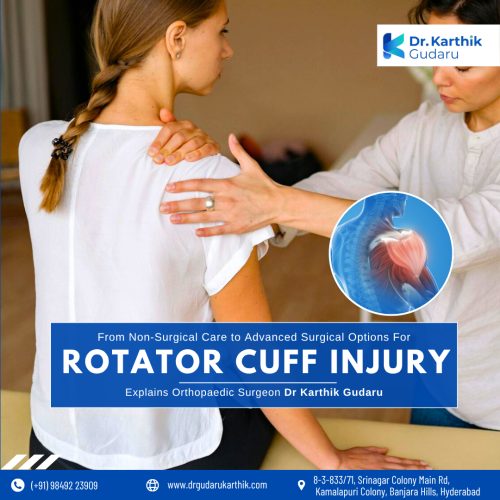
Recovery and Rehabilitation
Post-treatment, a structured rehabilitation program is essential for full recovery. It typically includes progressive exercises to restore motion, strength, and stability. Recovery times vary, from a few weeks for minor strains to several months after surgery. Patience and consistency in physiotherapy are key to regaining shoulder function.
A rotator cuff injury, though common, can significantly affect daily life if left untreated. Early diagnosis and appropriate treatment—whether through rest, physiotherapy, or advanced surgical options—can lead to excellent recovery and prevent long-term complications. Maintaining shoulder health through regular exercise, posture correction, and avoiding repetitive strain ensures strength, stability, and pain-free motion for years to come.
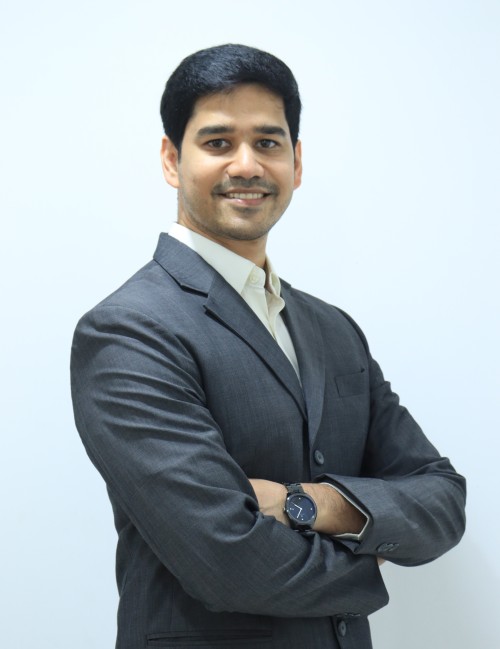
Dr Karthik Gudaru, MS Orthopaedics, MBBS, Fellowship in Knee and Hip Arthroplasty (USA), Fellowship in Computer-Assisted Navigation Joint Replacement Surgery (Germany), is one of Hyderabad’s leading orthopaedic surgeons with an outstanding reputation for precision, innovation, and excellence in joint replacement and orthopaedic care. Widely recognised as the best knee replacement specialist in Hyderabad, he brings a deep commitment to patient-centred care and cutting-edge surgical techniques.
Dr Karthik Gudaru is currently the Senior Orthopaedic and Joint Replacement Specialist, Department of Orthopaedics at GreenMed Hospital, Srinagar Colony, Hyderabad, Assistant Professor and Consultant Orthopaedic at BIRRD Hospital (Balaji Institute of Surgery, Research and Rehabilitation for the Disabled), Tirupati and Joint Replacement & Pediatric Orthopedic Specialist at Sri Maruthi Hospitals, Tirupati.
Dr Karthik Gudaru’s Treatment Specialisation are –
Knee Joint Treatments (Including Total Knee Replacement Surgery).
Shoulder Joint Treatments (Including Total Shoulder Replacement Surgery).
Hip Joint Treatments (Including Total Hip Replacement Surgery).
Elbow Joint Treatments (Including Total Elbow Arthroscopy).
Computer-Assisted Knee Replacement Surgery.
Stem Cell Therapy for key orthopaedic treatments.
Pediatric Orthopedics Surgeon for Cerebral Palsy, Congenital Anomalies, Poliomyelitis & Metabolic Bone Diseases