
Knee pain has become one of the most common health complaints today, affecting people across all age groups—from young athletes to working professionals and senior citizens. Whether caused by injury, wear and tear, or degenerative conditions, damaged knees can significantly reduce mobility and quality of life. While conventional treatments like pain medications, physiotherapy, and surgery have long been the standard, medical science is now offering a promising alternative: stem cell therapy.
In Hyderabad, this advanced regenerative treatment is gaining attention for its ability to repair damaged knee tissues naturally and potentially delay or avoid surgery from Dr Karthik Gudaru, a leading orthopaedic surgeon and one of the most experienced stem cell therapists for knee joint treatments in Hyderabad.
How Knees Get Damaged?
The knee joint is one of the most complex and heavily used joints in the human body. It bears body weight, enables movement, and absorbs shock during daily activities such as walking, climbing stairs, or running. Because of this constant stress, knees are particularly vulnerable to damage, says Dr Karthik Gudaru, who is one of Hyderabad’s top surgeons and a specialist orthopaedic for knee joint treatments.
One of the most common causes of knee damage is osteoarthritis, a degenerative condition where the cartilage cushioning the knee joint gradually wears away. As cartilage thins, bones begin to rub against each other, leading to pain, stiffness, swelling, and reduced mobility. Ageing is a major risk factor, but obesity, genetics, and previous joint injuries can accelerate the process.
Sports injuries are another major contributor. Ligament tears (such as ACL injuries), meniscus tears, and cartilage damage are common among athletes and physically active individuals. Even after initial healing, these injuries can weaken the joint over time and increase the risk of long-term degeneration.
A sedentary lifestyle also plays a role. Prolonged sitting, poor posture, weak muscles, and lack of regular exercise reduce blood circulation around the knee joint, leading to stiffness and gradual joint deterioration. On the other hand, overuse injuries, repetitive strain, and improper exercise techniques can also damage knee structures.
In many cases, knee damage progresses slowly and silently until pain and mobility issues become severe—often when surgical intervention is suggested.
Limitations of Traditional Knee Treatments
Conventional knee treatments usually focus on symptom management rather than tissue repair. Painkillers and anti-inflammatory medications provide temporary relief but do not reverse joint damage. Physiotherapy helps strengthen surrounding muscles, but cannot regenerate lost cartilage. In advanced cases, patients are advised to undergo knee replacement surgery, which, although effective, involves significant costs, recovery time, and surgical risks.
This gap between symptom relief and actual healing has led to growing interest in regenerative medicine, particularly stem cell therapy.
What Is Stem Cell Therapy for Knee Damage?
Stem cell therapy is a form of regenerative treatment that uses the body’s own healing cells to repair damaged tissues. Stem cells possess the unique ability to differentiate into various types of cells, promoting tissue regeneration, reducing inflammation, and enhancing healing.
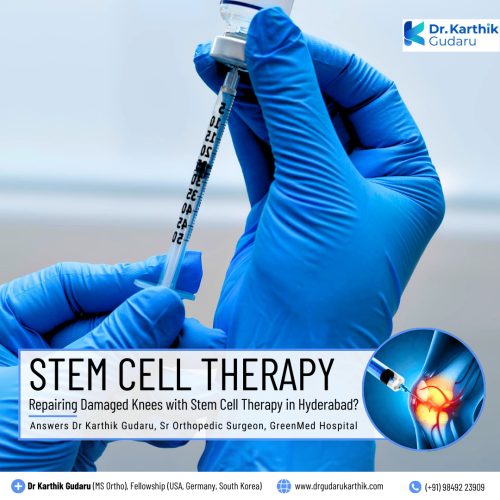
In knee treatments, stem cells are usually derived from the patient’s own bone marrow or adipose (fat) tissue. These cells are processed and then injected directly into the damaged knee joint under medical guidance. Once introduced, stem cells work by stimulating the repair of cartilage, ligaments, and other joint tissues while also reducing inflammation and pain.
How Stem Cell Therapy Helps Repair Damaged Knees?
Stem cell therapy addresses knee problems at their root rather than merely masking symptoms. One of its key benefits is cartilage regeneration. While traditional treatments cannot restore worn-out cartilage, stem cells encourage the body to rebuild damaged tissue, potentially slowing or even reversing joint degeneration.
Another major advantage is pain reduction and improved mobility. By decreasing inflammation inside the joint, stem cell therapy often leads to significant pain relief and enhanced joint flexibility. Many patients report improved function within weeks to months of treatment.
Stem cell therapy is also minimally invasive, making it an attractive option for patients who wish to avoid surgery. The procedure typically involves injections rather than incisions, resulting in minimal downtime and faster recovery. Importantly, this therapy uses the patient’s own cells, which significantly reduces the risk of allergic reactions or rejection.
Stem Cell Therapy for Knees in Hyderabad
Hyderabad has emerged as a leading destination for advanced orthopaedic and regenerative treatments, thanks to highly patient-friendly surgeons like Dr Karthik Gudaru. The city is home to experienced orthopaedic specialists, modern medical facilities, and cutting-edge technology. Patients seeking stem cell therapy for knee damage in Hyderabad benefit from a combination of medical expertise and comparatively affordable treatment options.
This therapy is especially suitable for patients with early to moderate osteoarthritis, cartilage damage, ligament injuries, and those who are not ideal candidates for surgery or who wish to postpone knee replacement.
Is Stem Cell Therapy Right for You?
While stem cell therapy shows promising results, it may not be suitable for everyone. The success of treatment depends on factors such as age, severity of knee damage, overall health, and lifestyle. A thorough evaluation by an experienced orthopaedic or regenerative medicine specialist is essential to determine eligibility and expected outcomes.
Knee damage no longer has to mean living with chronic pain or rushing into surgery. Stem cell therapy represents a new frontier in knee care—one that focuses on healing, regeneration, and long-term joint health. For patients in Hyderabad, this innovative treatment from one of the top orthopaedic surgeons for the knee joint, Dr Karthik Gudaru, offers hope for improved mobility, reduced pain, and a better quality of life. As medical science continues to advance, regenerative therapies like stem cell treatment are redefining how damaged knees are repaired—naturally and effectively.

Dr Karthik Gudaru, MS Orthopaedics, MBBS, Fellowship in Knee and Hip Arthroplasty (USA), Fellowship in Computer-Assisted Navigation Joint Replacement Surgery (Germany), is one of Hyderabad’s leading orthopaedic surgeons with an outstanding reputation for precision, innovation, and excellence in joint replacement and orthopaedic care. Widely recognised as the best knee replacement specialist in Hyderabad, he brings a deep commitment to patient-centred care and cutting-edge surgical techniques.
Dr Karthik Gudaru is currently the Senior Orthopaedic and Joint Replacement Specialist, Department of Orthopaedics at GreenMed Hospital, Srinagar Colony, Hyderabad, Assistant Professor and Consultant Orthopaedic at BIRRD Hospital (Balaji Institute of Surgery, Research and Rehabilitation for the Disabled), Tirupati and Joint Replacement & Pediatric Orthopedic Specialist at Sri Maruthi Hospitals, Tirupati.
Dr Karthik Gudaru’s Treatment Specialisation are –
Knee Joint Treatments (Including Total Knee Replacement Surgery).
Shoulder Joint Treatments (Including Total Shoulder Replacement Surgery).
Hip Joint Treatments (Including Total Hip Replacement Surgery).
Elbow Joint Treatments (Including Total Elbow Arthroscopy).
Computer-Assisted Knee Replacement Surgery.
Stem Cell Therapy for key orthopaedic treatments.
Pediatric Orthopedics Surgeon for Cerebral Palsy, Congenital Anomalies, Poliomyelitis & Metabolic Bone Diseases