
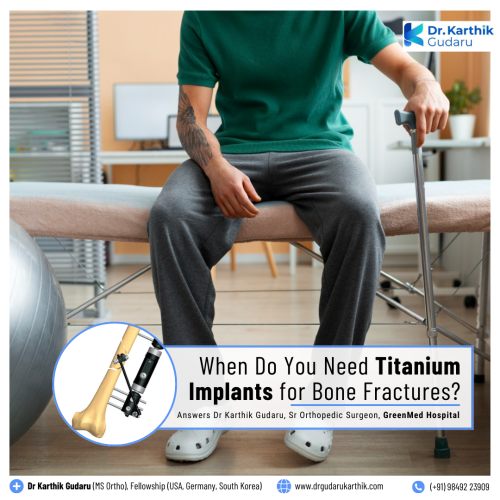
Fractured Bone? Here’s What Hyderabad’s Leading Orthopaedic Surgeon, Dr Karthik Gudaru, Says About Titanium Implants
A major bone fracture is considered a serious orthopedic injury because bones play a critical role in movement, stability, and weight bearing. Damage to important bones can significantly affect a person’s ability to stand, walk, or perform daily activities.
Fractures commonly occur due to road traffic accidents, falls from height, sports injuries, direct trauma, or in elderly individuals due to osteoporosis where even a minor fall can cause a fracture. Because bones are essential for mobility and body support, proper treatment is necessary, and in many cases titanium implants are required to ensure correct healing and long-term function, explains Dr Karthik Gudaru, who is an experienced orthopedic surgeon in Hyderabad and Telangana.
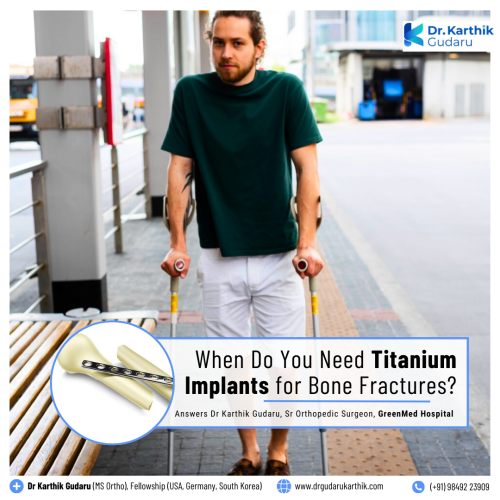
What Are Titanium Implants?
Titanium implants are specialized medical devices made from medical-grade titanium or titanium alloys and are widely used in orthopedic surgeries to stabilize broken bones. These implants include plates, screws, rods, wires, and intramedullary nails that are placed inside the body during surgery to hold fractured bones in proper alignment while healing occurs. Titanium is preferred over many other metals because it is strong yet lightweight, resistant to corrosion, and highly biocompatible, meaning it is well accepted by the human body with minimal risk of allergic reactions or rejection.
One of the major advantages of titanium implants is their ability to withstand stress, especially in weight-bearing bones. They provide rigid internal support, allowing bones to heal in the correct position and shape. Unlike external casts or braces, titanium implants stabilize the fracture from inside the body and often allow earlier movement of the affected limb. In many cases, these implants are designed to remain in place permanently unless they cause discomfort or complications later.
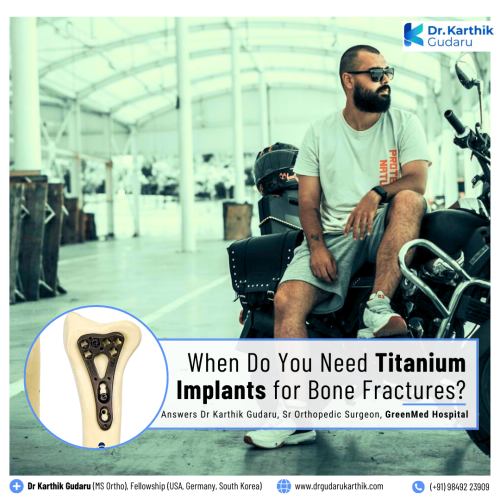
Why Are Titanium Implants Important in Fracture Treatment?
Bones such as the femur, tibia, pelvis, and spine experience constant stress during standing, walking, and movement. Because of this, fractures in these areas often require strong and stable fixation. Conservative treatment like plaster or traction is often insufficient in moderate to severe fractures, especially in adults. Titanium implants provide the stability needed to prevent bone fragments from shifting, reduce pain, and allow controlled movement during recovery.
Another important advantage is faster rehabilitation. With stable internal fixation, patients can begin physiotherapy earlier, helping maintain muscle strength, prevent joint stiffness, and reduce complications associated with prolonged bed rest. This is particularly important in elderly patients and those with existing medical conditions.
.
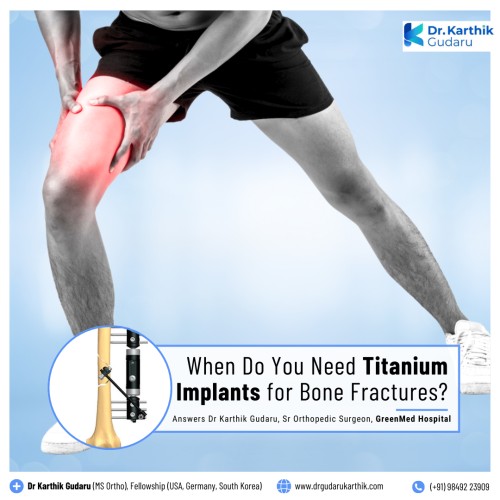
Fractures Where Titanium Implants Are Commonly Used
Titanium implants are used in femur or thigh bone fractures, including femoral shaft fractures, comminuted fractures where the bone breaks into multiple pieces, fractures near the hip joint, and fractures near the knee joint. Because the femur carries full body weight, strong internal fixation is often necessary for proper healing.
Hip fractures, including femoral neck fractures and intertrochanteric fractures, frequently require titanium fixation, especially in elderly patients with osteoporosis. These implants help restore joint stability and allow early movement, which is essential for preventing complications related to immobility.
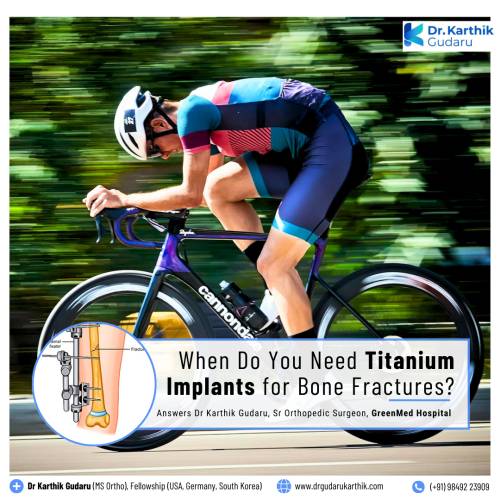
Fractures of the tibia and fibula in the lower leg often require titanium implants when the fracture is unstable, involves joints, or is associated with soft tissue injury. Because these bones play a major role in weight bearing and walking, internal fixation helps maintain alignment and stability.
Titanium implants are also widely used in upper limb fractures. This includes humerus fractures in the upper arm and radius and ulna fractures in the forearm, particularly when fractures are displaced, unstable, or involve nearby joints. Shoulder and clavicle fractures may also require titanium plates and screws when conservative treatment cannot maintain proper bone alignment.
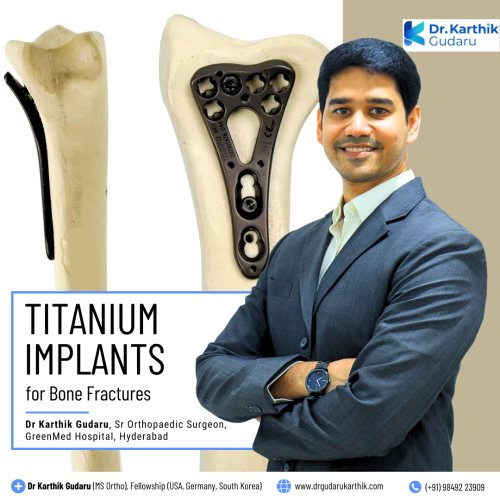
In complex trauma cases, pelvic fractures and acetabular fractures often require titanium implants to restore structural stability and protect internal organs. Similarly, spinal fractures involving vertebrae may require titanium rods and screws to stabilize the spine and protect the spinal cord.
Titanium implants are also used in smaller but complex bones such as those in the hand, wrist, foot, and ankle. Wrist fractures, scaphoid fractures, metacarpal fractures, ankle fractures, heel bone fractures, and midfoot injuries often need internal fixation when alignment is critical for normal movement and weight bearing.
In facial and jaw fractures, titanium mini plates and screws are commonly used in maxillofacial surgery to stabilize bones and restore normal facial structure and function.
Open fractures, where the broken bone pierces through the skin, almost always require surgical fixation with implants. These injuries carry a high risk of infection and instability, and titanium implants help stabilize the bone while allowing proper wound care and healing. Fractures associated with nerve or blood vessel injury also often require immediate surgical fixation using implants.
Patients with osteoporosis or poor bone quality are another group where titanium implants are commonly recommended because weakened bones may not hold alignment with conservative treatment alone.
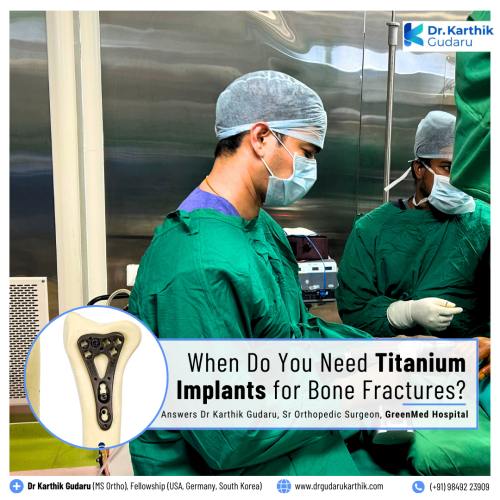
When Do You Need Titanium Implants?
Titanium implants are usually recommended when fractures are severe, unstable, displaced, involve joints, occur in weight-bearing bones, or are unlikely to heal properly without surgical support. The decision also depends on patient age, bone quality, fracture pattern, and overall medical condition.
Titanium implants play a crucial role in modern fracture treatment across multiple bones in the body. Their strength, durability, and excellent compatibility with the human body make them ideal for providing stable fixation and promoting effective healing. The decision to use titanium implants depends on the type of fracture and the patient’s overall condition. An experienced orthopedic surgeon can evaluate these factors and recommend the most appropriate treatment approach to ensure safe recovery and a return to normal mobility.
Why Titanium Implants Instead of Stainless Steel?
Titanium implants are often preferred over stainless steel mainly because of their superior biocompatibility and lower infection risk. Titanium forms a natural oxide layer on its surface, which makes it highly resistant to corrosion inside the body and reduces bacterial adhesion compared to stainless steel. This means bacteria are less likely to attach and form biofilms, which are a major cause of implant-related infections.
Titanium is also lighter, more flexible, and closer to the natural elasticity of bone, which reduces stress on surrounding bone tissue. In contrast, stainless steel is stronger in some situations but can sometimes trigger more local tissue reaction and has a slightly higher chance of corrosion over long periods, especially in complex fracture environments.
Another important difference between titanium and stainless steel is how they behave during long-term implantation and imaging procedures. Titanium is non-magnetic, which makes it safer and more compatible with MRI scans, allowing patients to undergo future diagnostic imaging with fewer concerns. It is also less likely to cause metal sensitivity or allergic reactions compared to stainless steel.
Over time, titanium implants tend to integrate better with surrounding bone and tissues, which supports long-term stability and comfort. Stainless steel implants, while still widely used and effective in many fracture treatments, are generally considered more suitable for temporary fixation or specific fracture patterns where very high initial strength is required.

Dr Karthik Gudaru, MS Orthopaedics, MBBS, Fellowship in Knee and Hip Arthroplasty (USA), Fellowship in Computer-Assisted Navigation Joint Replacement Surgery (Germany), is one of Hyderabad’s leading orthopaedic surgeons with an outstanding reputation for precision, innovation, and excellence in joint replacement and orthopaedic care. Widely recognised as the best knee replacement specialist in Hyderabad, he brings a deep commitment to patient-centred care and cutting-edge surgical techniques.
Dr Karthik Gudaru is currently the Senior Orthopaedic and Joint Replacement Specialist, Department of Orthopaedics at GreenMed Hospital, Srinagar Colony, Hyderabad, Assistant Professor and Consultant Orthopaedic at BIRRD Hospital (Balaji Institute of Surgery, Research and Rehabilitation for the Disabled), Tirupati and Joint Replacement & Pediatric Orthopedic Specialist at Sri Maruthi Hospitals, Tirupati.
Dr Karthik Gudaru’s Treatment Specialisation are –
Knee Joint Treatments (Including Total Knee Replacement Surgery).
Shoulder Joint Treatments (Including Total Shoulder Replacement Surgery).
Hip Joint Treatments (Including Total Hip Replacement Surgery).
Elbow Joint Treatments (Including Total Elbow Arthroscopy).
Computer-Assisted Knee Replacement Surgery.
Stem Cell Therapy for key orthopaedic treatments.
Pediatric Orthopedics Surgeon for Cerebral Palsy, Congenital Anomalies, Poliomyelitis & Metabolic Bone Diseases