

Summary
- Occasional toe walking can be a normal part of early walking development.
- Persistent toe walking may sometimes be linked to tight calf muscles or other movement-related concerns.
- If a child cannot keep their heels down or toe walking continues frequently, a specialist assessment can help identify the cause.
This Article is Medically Reviewed by Dr Karthik Gudaru, MS Orthopaedics, Fellowship in Computer-Assisted Navigation and Joint Replacement Surgery (Germany), HOD Orthopaedic Department, GreenMed Hospitals, Hyderabad and Senior Paediatric Orthopaedic Surgeon, Sri Maruthi Hospitals, Tirupati
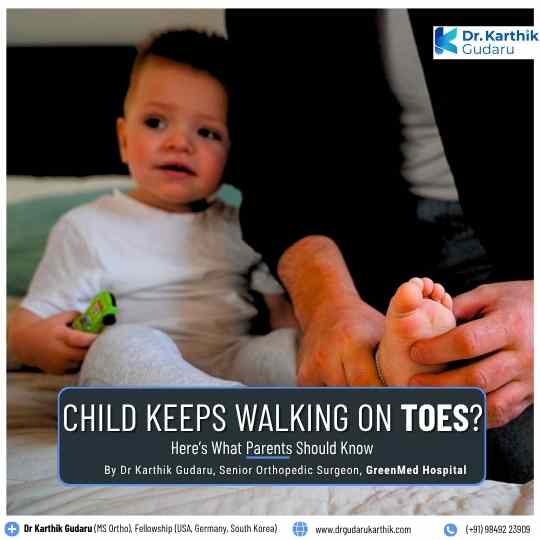
Toe walking is something many parents notice when their child is learning to walk. In the early stages, walking on the toes can simply be part of learning balance, coordination, and a comfortable walking pattern. But when a child continues to walk on their toes well beyond the toddler years, parents may naturally begin to wonder whether it is still normal.
Persistent toe walking does not always mean there is a serious problem. In some children, it happens without any underlying medical condition. However, continued toe walking can sometimes be linked to tight calf muscles, differences in muscle or nerve function, or certain developmental conditions.
This is why the child’s age, walking pattern, and overall development are important when deciding whether an evaluation is needed. Shares Dr Karthik Gudaru, Specialist Paediatric Orthopaedics Surgeon and Knee Replacement specialist in Hyderabad, Tirupati,(Telangana) Vijayawada, and Guntur (Andhra Pradesh).
When Should Toe Walking Become a Concern?
The key question is not simply “Does my child walk on their toes?” but “How often does it happen, how long has it continued, and can my child walk with their heels down?”
If a child can easily walk with their entire foot on the ground but occasionally goes up on their toes, it may be less concerning. On the other hand, if toe walking is persistent, happens on both feet, becomes more frequent, or the child cannot comfortably place their heels down, it is worth discussing with a paediatrician or paediatric orthopaedic specialist.
“Persistent toe walking doesn’t always mean something is wrong, but it’s a walking pattern worth understanding.” Says Dr Karthik Gudaru, Senior Orthopedic Surgeon and a Specialist Paediatric Orthopaedic Doctor.
Common Reasons Children Walk on Their Toes
There are several possible reasons for persistent toe walking, and they can vary from one child to another.
- Habit or walking pattern: Some children simply develop a preference for walking on their toes.
- Tight calf muscles: Limited flexibility around the ankle can make heel-to-toe walking more difficult.
- Muscle or nerve-related conditions: In some cases, toe walking may be associated with problems affecting muscles, nerves, or movement.
- Developmental differences: Persistent toe walking can sometimes occur alongside certain developmental conditions, although toe walking by itself does not mean a child has one.
A proper assessment helps determine which explanation is most likely rather than assuming that every child who toe walks has a medical condition.
Signs Parents Should Watch For
Toe walking deserves closer attention when it is accompanied by other changes in movement or development. Parents may notice that the child:
- Walks on their toes most of the time
- Has difficulty putting their heels flat on the floor
- Seems to have tight calf muscles
- Trips or falls frequently
- Has difficulty keeping up with other children physically
- Has noticeable differences between the two legs
- Has difficulty with balance or coordination
These signs do not necessarily indicate a serious problem, but they can help a doctor understand the bigger picture.
Why an Early Assessment Can Help
A child who continues to toe walk should not automatically be labeled as having an orthopaedic problem. At the same time, persistent toe walking should not always be dismissed as a habit.
An assessment can look at the child’s walking pattern, ankle movement, muscle flexibility, strength, coordination, and overall development. If treatment is needed, identifying the issue earlier can make it easier to address before stiffness or changes in walking mechanics become more established.
What Treatment May Involve
Treatment depends on why the child is toe walking and how much it is affecting movement. Some children may only need observation and regular follow-up. Others may benefit from stretching exercises, physiotherapy, supportive footwear, or other treatments recommended by a specialist.
If the calf muscles or Achilles tendon have become tight, the treatment approach may be different from that for a child whose toe walking is mainly habitual. In more persistent cases, a paediatric orthopaedic specialist may recommend additional options based on the child’s individual needs.
When Should Parents See a Specialist?
If your child continues to walk on their toes frequently, particularly beyond the early walking years (around 2 years of age), particularly beyond the early walking years, it is reasonable to have the walking pattern assessed. An evaluation becomes especially important if the child cannot put their heels down, has stiffness, walks differently on one side, or has other movement or developmental concerns.
The important thing is not to panic—but also not to ignore a persistent pattern. Toe walking can be harmless in some children, while in others it may be a sign that deserves further evaluation. A professional assessment can help parents understand which situation applies to their child.

Dr Karthik Gudaru, MS Orthopaedics, MBBS, Fellowship in Knee and Hip Arthroplasty (USA), Fellowship in Computer-Assisted Navigation Joint Replacement Surgery (Germany), is one of Hyderabad’s leading orthopaedic surgeons with an outstanding reputation for precision, innovation, and excellence in joint replacement and orthopaedic care. Widely recognised as the best knee replacement specialist in Hyderabad, he brings a deep commitment to patient-centred care and cutting-edge surgical techniques.
Dr Karthik Gudaru is currently the Senior Orthopaedic and Joint Replacement Specialist, Department of Orthopaedics at GreenMed Hospital, Srinagar Colony, Hyderabad; Assistant Professor and Consultant Orthopaedic at BIRRD Hospital (Balaji Institute of Surgery, Research and Rehabilitation for the Disabled), Tirupati; and Joint Replacement & Pediatric Orthopaedic Specialist at Sri Maruthi Hospitals, Tirupati.
Dr Karthik Gudaru’s treatment specialisations –
Total Knee Replacement Surgery.
Total Shoulder Replacement Surgery.
Hip Joint Treatments
Total Elbow Arthroscopy.
Computer-Assisted Knee Replacement Surgery.
Stem Cell Therapy for key orthopaedic treatments.
Pediatric Orthopaedics Treatments for Cerebral Palsy, Congenital Anomalies, Poliomyelitis & Metabolic Bone Diseases
Hospital Affiliations
OPD, GreenMed Hospital, 8-3-833/71, Srinagar Colony Main Rd, Kamalapuri Colony, Banjara Hills, Hyderabad, Telangana
Durgabai Deshmukh Hospital, Vidyanagar, Hyderabad
Sri Maruthi Hospitals, OPD, 19-3-30/C1, Near RTC Bus Stand, Kennedy Nagar, Tirupati, 517501
BIRRD Hospital, Tirupati (Consultant & Asst. Professor)
Education and Affiliation
MBBS: Kasturba Medical College, Manipal University, Karnataka (2012), Registration No: TSMC/FMR/16001
MS (Orthopaedics): Sri Ramachandra Medical College & Research Institute, Chennai (2016), Registration No: 119525
Knee & Hip Arthroplasty Fellowship: Dartmouth Hospital, USA (2018)
Robotic & Computer-Assisted Joint Replacement Fellowship: Asklepios Hospital, Germany (2018)
AO Trauma & Emergency Orthopaedic Care Fellowship: Guro National Hospital, South Korea (2019–2020)
Spinal Surgery Observer Training: Yonsei University, South Korea (2015)