

Summary
- Avoid sitting cross-legged for prolonged periods.
- Change your sitting position and move regularly.
- Persistent knee, hip, or back discomfort should not be ignored.
This Article is Medically Reviewed by Dr Karthik Gudaru, MS Orthopaedics, Fellowship in Computer-Assisted Navigation and Joint Replacement Surgery (Germany), HOD, Orthopaedic Department, GreenMed Hospitals (Hyderabad), Ramesh Hospital (Vijayawada), and Guntur Maruthi Hospital (Tirupati).
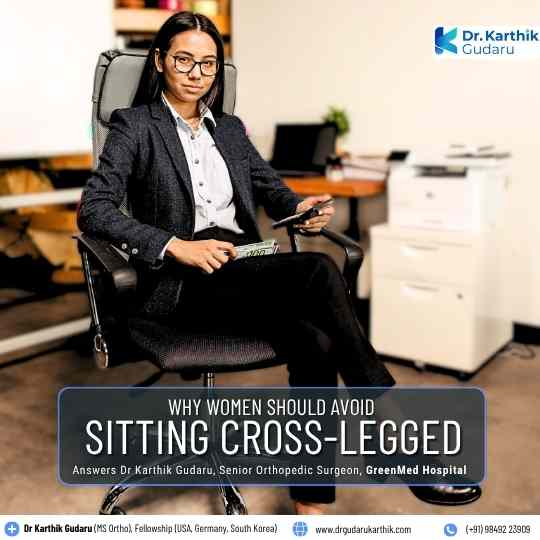
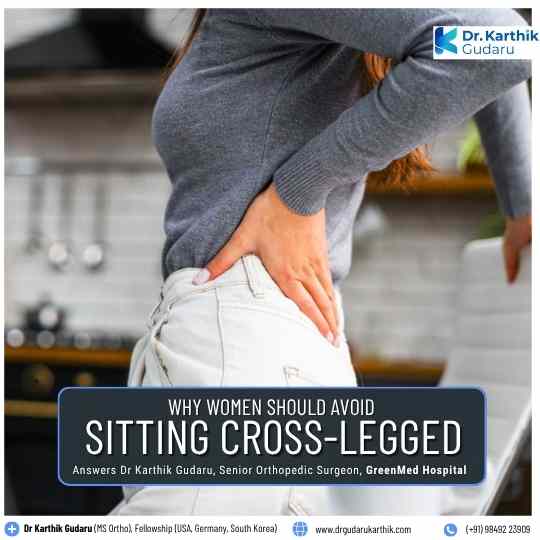
Sitting cross-legged is a common posture for women while working, relaxing, travelling, or sitting on the floor. For many people, crossing the legs occasionally is unlikely to cause a serious problem. However, spending long periods in this position may place additional stress on the hips, knees, and lower back, particularly in people who already have joint or posture-related problems.
According to orthopaedic specialists, the concern is not necessarily about crossing your legs once in a while, but about remaining in the same position for prolonged periods without changing posture, shares Dr Karthik Gudaru, Senior Orthopaedic Surgeon, Pediatric Orthopaedic Doctor and Joint Replacement Specialist Surgeon.
Why Can Sitting Cross-Legged Become a Problem for Women?
Sitting cross-legged changes the position of the hips and knees and can affect the alignment of the lower body. When maintained for a long time, it may contribute to stiffness and discomfort, especially in people with existing joint problems or limited flexibility.
Women who spend several hours sitting this way every day may therefore benefit from changing positions regularly and avoiding prolonged static postures.
“The problem is not simply crossing your legs; it is spending too much time in one position without allowing your joints and muscles to move.”
Prolonged Pressure on the Knees
When one leg rests over the other, the knee remains in a bent and rotated position. Staying like this for extended periods can make the knees feel stiff or uncomfortable, particularly in people who already have knee problems.
Hip Stiffness Can Develop
Cross-legged sitting requires a certain degree of hip rotation and flexibility. People with restricted hip movement may experience discomfort or stiffness when maintaining the position for too long.
Regularly changing position can reduce prolonged stress on the hip joints.
It May Affect Your Lower Back
The pelvis can shift when sitting cross-legged, especially if the posture is maintained for a long time. This may influence the position of the spine and contribute to lower-back discomfort in some individuals. Maintaining a neutral sitting posture and supporting the lower back can be more comfortable during prolonged sitting.
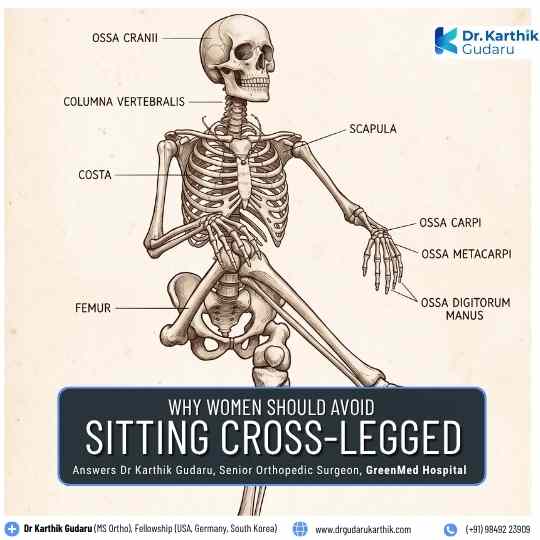
Existing Joint Problems Need Extra Attention
Women with arthritis, previous knee or hip injuries, significant stiffness, or persistent back pain may find cross-legged sitting particularly uncomfortable. In such cases, the problem is less about the posture itself and more about how the joints respond to it. If a particular sitting position repeatedly causes pain, it should not be ignored.
Avoid Staying in One Position for Too Long
One of the simplest ways to reduce sitting-related discomfort is to keep moving. Stand up, walk around, stretch gently, or change your sitting position periodically. Even a comfortable posture can become problematic when maintained continuously for several hours.
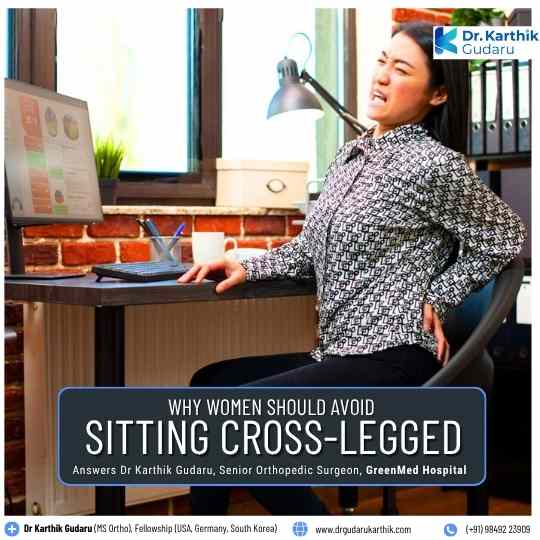
Listen to What Your Body Is Telling You
Occasional cross-legged sitting is not automatically harmful for everyone. However, pain, numbness, tingling, persistent stiffness, or swelling after sitting in a particular position may indicate that your joints or muscles are not tolerating it well.
If these symptoms continue or interfere with daily activities, an orthopedist evaluation may be appropriate.
When Should You Seek an Orthopaedic Doctor’s Consultation?
If sitting cross-legged regularly causes persistent knee, hip, or lower-back pain, stiffness, swelling, numbness, or difficulty with movement, it is advisable to consult an orthopedist for proper evaluation.
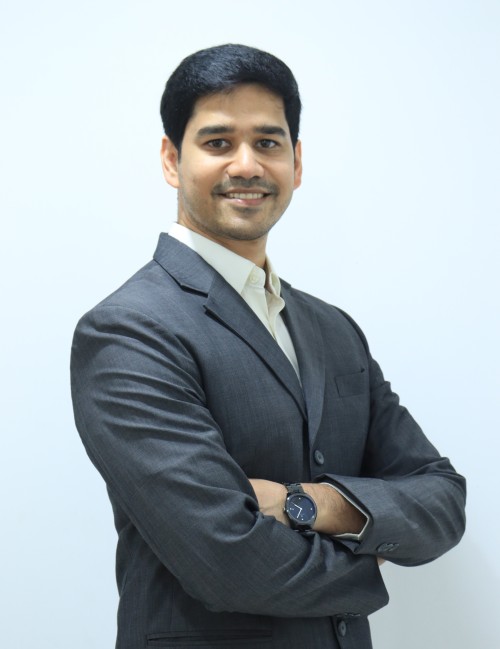
Dr Karthik Gudaru, MS Orthopaedics, MBBS, Fellowship in Knee and Hip Arthroplasty (USA), Fellowship in Computer-Assisted Navigation Joint Replacement Surgery (Germany), is one of Hyderabad’s leading orthopaedic surgeons with an outstanding reputation for precision, innovation, and excellence in joint replacement and orthopaedic care. Widely recognised as the best knee replacement specialist in Hyderabad, he brings a deep commitment to patient-centred care and cutting-edge surgical techniques.
Dr Karthik Gudaru is currently the Senior Orthopaedic and Joint Replacement Specialist, Department of Orthopaedics at GreenMed Hospital, Srinagar Colony, Hyderabad; Assistant Professor and Consultant Orthopaedic at BIRRD Hospital (Balaji Institute of Surgery, Research and Rehabilitation for the Disabled), Tirupati; and Joint Replacement & Pediatric Orthopaedic Specialist at Sri Maruthi Hospitals, Tirupati.
Dr Karthik Gudaru’s treatment specialisations –
Total Knee Replacement Surgery.
Total Shoulder Replacement Surgery.
Hip Joint Treatments
Total Elbow Arthroscopy.
Computer-Assisted Knee Replacement Surgery.
Stem Cell Therapy for key orthopaedic treatments.
Pediatric Orthopaedics Treatments for Cerebral Palsy, Congenital Anomalies, Poliomyelitis & Metabolic Bone Diseases
Hospital Affiliations
OPD, GreenMed Hospital, 8-3-833/71, Srinagar Colony Main Rd, Kamalapuri Colony, Banjara Hills, Hyderabad, Telangana
Durgabai Deshmukh Hospital, Vidyanagar, Hyderabad
Sri Maruthi Hospitals, OPD, 19-3-30/C1, Near RTC Bus Stand, Kennedy Nagar, Tirupati, 517501
BIRRD Hospital, Tirupati (Consultant & Asst. Professor)
Education and Affiliation
MBBS: Kasturba Medical College, Manipal University, Karnataka (2012), Registration No: TSMC/FMR/16001
MS (Orthopaedics): Sri Ramachandra Medical College & Research Institute, Chennai (2016), Registration No: 119525
Knee & Hip Arthroplasty Fellowship: Dartmouth Hospital, USA (2018)
Robotic & Computer-Assisted Joint Replacement Fellowship: Asklepios Hospital, Germany (2018)
AO Trauma & Emergency Orthopaedic Care Fellowship: Guro National Hospital, South Korea (2019–2020)
Spinal Surgery Observer Training: Yonsei University, South Korea (2015)