

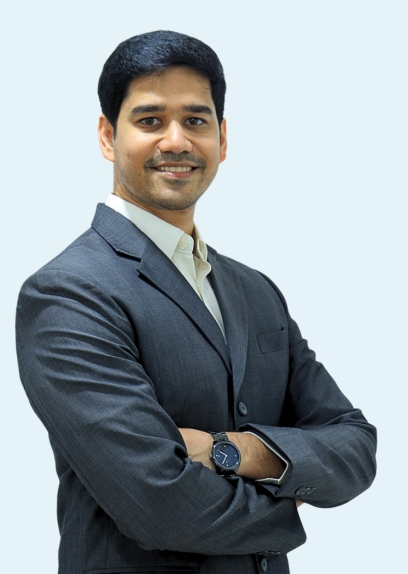
MBBS, MS Orthopaedics, Fellowship in Knee and Hip Arthroplasty (USA), Fellowship in Computer Assisted Navigation Joint Replacement Surgery (Germany)

Recognized as one of South India’s foremost authorities in adult joint preservation, robotic reconstructive surgery, and complex arthritis management, Dr Karthik Gudaru brings over a decade of elite surgical mastery and global fellowship training to patients across Telangana and Andhra Pradesh
With an established clinical record encompassing over 12,000 successful orthopedic surgeries and 4,000+ joint replacements, his operative foundations were forged at premier orthopedic centers worldwide. He completed advanced subspecialty fellowships in Knee & Hip Arthroplasty at Dartmouth Hospital (USA), Robotic & Computer-Assisted Navigation Joint Replacement at Asklepios Hospital (Germany), and AO Trauma & Emergency Care at Guro National Hospital (South Korea).
Today, as Senior Consultant Orthopedic Surgeon at GreenMed Hospital (Banjara Hills / Srinagar Colony, Hyderabad), Visiting Specialist at Aster Ramesh Hospital (Vijayawada), and Assistant Professor & Consultant at BIRRD Hospital and Sri Maruthi Hospitals (Tirupati), Dr Gudaru delivers evidence-based, protocol-driven arthritis care. Utilizing joint-sparing High Tibial Osteotomies (HTO), subvastus muscle-preserving approaches, sub-millimeter robotic precision, and biological regenerative therapies, his practice is designed to eliminate chronic arthritic agony, preserve natural joint biomechanics, and restore active, independent mobility.
| Quick Summary for Patients | |
|---|---|
| Surgeon |
Dr Karthik Gudaru — MBBS, MS (Orthopaedics) Fellowships in Joint Arthroplasty & Navigation (USA, Germany, South Korea) |
| Education & Credentials |
MBBS:
Kasturba Medical College, Manipal University, Karnataka (TSMC Reg. No: TSMC/FMR/16001)
MS (Orthopaedics):
Sri Ramachandra Medical College & Research Institute, Chennai (Reg. No: 119525)
USA Fellowship:
Knee & Hip Arthroplasty, Dartmouth Hospital, USA (2018)
Germany Fellowship:
Computer-Assisted Navigation & Robotic Joint Replacement, Asklepios Hospital, Germany (2018)
South Korea Fellowships:
AO Trauma & Emergency Care, Guro National Hospital (2019–2020); Spinal Surgery Observer, Yonsei University (2015)
|
| Appointments |
Current (Hyderabad):
Senior Consultant Orthopedic & Joint Replacement Surgeon, GreenMed Hospital, Srinagar Colony / Banjara Hills
Current (Tirupati):
Assistant Professor & Consultant Orthopedic Surgeon, BIRRD Hospital (Balaji Institute of Surgery, Research and Rehabilitation for the Disabled)
Visiting Specialist:
Aster Ramesh Hospital (Vijayawada) & Sri Maruthi Hospitals (Tirupati)
|
| Awards & Honors | Recipient of the prestigious "Vaidya Rathna" Award (2023) for outstanding surgical precision and clinical service in joint reconstruction. |
| Arthritis Care Model | Stepped-Care Paradigm, Biological Joint Preservation First, Subvastus Muscle-Sparing Access (Zero Thigh Muscle Cutting), Sub-Millimeter Robotic & Optical Navigation (<0.5 mm / <0.5°), Native Ligament Preservation, Multimodal Adductor Canal Sensory Blocks, and Same-Day / 24-Hour Ambulation. |
| Procedures Offered | Total Knee Replacement (TKR) Primary Knee Replacement Revision Joint Replacement Knee Osteotomy (HTO) Robotic-Assisted Arthroplasty Computer-Assisted Navigation Surgery Arthroscopic Synovectomy Stem Cell & PRP Injections |
| Consultation Centers |
|
| Direct Helpline |
Direct Surgical Helpline & WhatsApp Desk:
+91 62814 22297
|

Arthritis encompasses over 100 pathological entities characterized by joint inflammation, cartilage degradation, subchondral bone remodeling, and functional restriction. Dr Gudaru applies structured staging and personalized surgical protocols across the primary forms of joint arthritis:
The most common form of arthritis, characterized by progressive, mechanical wear and tear of articular hyaline cartilage. As cartilage erodes, bone rubs on bone, triggering joint space narrowing, subchondral sclerosis, and painful osteophytes (bone spurs). Predominantly affecting weight-bearing joints—such as the knees, hips, and spine—osteoarthritis causes severe morning stiffness, mechanical grinding (crepitus), angular deformities (varus/bowlegs or valgus/knock-knees), and progressive walking limitations.
A systemic autoimmune disorder where the immune system attacks synovial membranes lining the joints. Chronic synovial inflammation (synovitis) releases destructive enzymes (pannus formation) that rapidly dissolve cartilage and erode bone. Rheumatoid arthritis typically affects joints bilaterally and symmetrically, leading to severe morning stiffness lasting over an hour, joint effusion, ligament attenuation, progressive joint instability, and multi-planar contractures.
Arthritis that develops secondary to previous joint trauma, such as intra-articular tibial plateau or femoral condyle fractures, meniscus tears, or cruciate ligament injuries. Even after initial bone union, subtle mechanical step-offs or altered joint kinematics cause accelerated cartilage breakdown years later. Patients experience localized pain, restricted flexion, joint swelling, and premature functional failure, often at an early age (30 to 50 years).
Arthritis affecting children and adolescents under 16 years of age, frequently associated with immune dysregulation, chronic synovial thickening, and skeletal growth plate disturbances. This can lead to limb length discrepancies, early angular deformities, and premature articular destruction. Management requires delicate coordination between medical disease control and bone-preserving pediatric reconstructive techniques to safeguard active skeletal growth.

Senior Orthopedic Surgeon Dr Karthik Gudaru treats joint arthritis through a stepped biological and robotic protocol:
Realigns mechanical stress off damaged compartments using High Tibial Osteotomy (HTO) or regenerative cell therapy, preserving 100% of native joint tissues.
Uses 3D optical navigation and robotic arms (<0.5 mm / <0.5° precision) with a muscle-sparing Subvastus approach that avoids cutting the quadriceps tendon.
Reconstructs extensive bone loss using modular revision systems, metaphyseal titanium sleeves, and specialized bone grafting.
This approach eliminates severe post-operative surgical pain, preserves stabilizing ligaments, allows walking within 4 to 12 hours, and extends implant durability beyond 25–30 years.
| Arthritis Stage & Clinical Condition | Primary Joint Symptoms & Pathology | Target Surgical Protocol | Anesthesia & In-Hospital Stay | Functional Recovery & Ambulation |
|---|---|---|---|---|
| Stage 1 & 2 Early Osteoarthritis | Intermittent joint stiffness, ache after exertion, preserved joint space | Regenerative Biotherapy & Viscosupplementation (Targeted PRP, HA, or Stem Cell Therapy) | Outpatient Daycare | Normal daily activities immediately |
| Stage 3 Unicompartmental OA / Post-Traumatic | Bone-on-bone localized strictly to the inner (medial) knee; varus bowleg | High Tibial Osteotomy (HTO) (Controlled wedge realigns weight-bearing axis) | Regional Block; 1 to 2 Days | Partial weight-bearing with crutches for 4–6 weeks; saves native joint |
| End-Stage Multi-Compartment Osteoarthritis | Severe chronic pain walking <100m, sleep disruption, bone-on-bone friction | Primary Total Knee Replacement (TKR) (Subvastus muscle-sparing resurfacing) | Regional Adductor Canal Block; 2 Days | Assisted walking in 4–12 hours; stairs & independent walking in 24–48 hours |
| Severe Angular Deformity / Complex Arthritis | Fixed bowleg/knock-knee (>15°), severe bone collapse, ligament laxity | Robotic-Assisted / Computer-Navigated Arthroplasty (Sub-millimeter haptic alignment) | Regional Sensor Block; 2 Days | Walk on the day of surgery; active fitness and routine in 3–4 weeks |
| Active Rheumatoid / Inflammatory Arthropathy | Chronic proliferative synovitis, multiple joint swelling, ligament stretching | Arthroscopic Synovectomy / Stage-Specific Reconstructive Arthroplasty | Regional Block; 1 to 2 Days | Rapid reduction of inflammatory swelling; return to activity in 2–3 weeks |
| Failed Past Joint Surgery / Implant Loosening | Implant wear, aseptic loosening, infection, severe instability after 15+ years | Complex Revision Arthroplasty (Removal of old prosthesis, titanium sleeves & bone grafting) | Specialized Regional Block; 3 to 4 Days | Assisted weight-bearing; progressive stability restored in 6–8 weeks |
Dr Karthik Gudaru performs advanced joint reconstruction and biological preservation procedures utilizing muscle-sparing access, robotic precision, and computer navigation:
Total Knee Replacement is an advanced anatomical resurfacing procedure indicated for end-stage tricompartmental osteoarthritis, advanced rheumatoid arthritis, or post-traumatic articular collapse. Rather than removing the entire joint, Dr Gudaru precisely debrides only the damaged 8 to 9 mm of worn articular cartilage and sclerotic subchondral bone from the femoral condyles and tibial plateau. The exposed bone ends are fitted with biocompatible cobalt-chromium or titanium components, separated by an ultra-high-molecular-weight polyethylene (UHMWPE) insert that restores smooth, frictionless joint kinematics.
Primary Knee Replacement refers to the virgin surgical intervention performed on a knee that has not had previous joint surgery. Dr Gudaru executes primary replacements using an advanced Subvastus (Muscle-Sparing) Approach. Traditional knee replacement involves a medial parapatellar incision that cuts directly through the quadriceps muscle tendon, resulting in significant post-operative pain, quadriceps inhibition, and delayed rehab. The Subvastus technique gently mobilizes and elevates the muscle belly intact without cutting it. This preserves complete extensor mechanism strength, reduces post-operative bleeding, and allows patients to straight-leg raise and walk within 4 to 12 hours of surgery.
Revision surgery is required when a previous knee replacement has loosened, developed polyethylene liner wear, suffered ligamentous instability, or contracted a periprosthetic joint infection after 15 to 25 years. Dr Gudaru is one of the few high-volume revision specialists in Telangana and Andhra Pradesh equipped to handle severe structural bone deficits. Utilizing advanced modular revision systems, porous titanium metaphyseal cones, stem extensions, and structural allograft bone reconstruction, he stabilizes joint lines and restores long-term pain-free weight-bearing.
For active patients under 55 suffering from unicompartmental (medial) osteoarthritis and bowleg (varus) deformity, total joint replacement is often premature. High Tibial Osteotomy is a joint-preserving biological operation. Dr Gudaru executes a calculated micro-wedge osteotomy in the proximal tibia, realigning the mechanical weight-bearing axis of the leg so that body weight is shifted from the worn inner compartment to the preserved, healthy lateral joint compartment. This relieves pain, halts progressive degeneration, and delays artificial joint replacement by 10 to 15+ years while keeping the patient's native joint intact.
Robotic arthroplasty provides real-time surgical precision during arthritis reconstruction. Utilizing dynamic optical tracking and 3D intra-operative CT anatomy mapping, Dr Gudaru plans the exact bone resections, component sizing, and ligament tension matching the patient’s natural anatomy. During surgery, he manipulates a robotic arm equipped with active haptic boundaries. The tool will not cut outside the pre-planned digital zone, guaranteeing 100% protection of the posterior cruciate ligament (PCL), collateral ligaments, and popliteal neurovascular bundle while executing resections with sub-millimeter accuracy (<0.5 mm and <0.5 degrees).
Computer-Assisted Navigation utilizes optical infrared sensor arrays affixed to the femur and tibia that communicate with an intra-operative navigation workstation. The platform tracks kinematic joint motion and soft-tissue laxity dynamically throughout the complete range of motion. This data allows Dr Gudaru to precisely position implants along the exact mechanical axis of the leg, eliminating human visual error and preventing early implant wear.
| Operative Metric | Conventional Manual Arthroplasty | Computer-Assisted Navigation (CAS) | Fully Robotic-Assisted Surgery |
|---|---|---|---|
| Pre-Operative Planning | 2D Plain Static X-Rays | Digital 2D/3D Anatomical Software | Patient-Specific 3D CT Virtual Model |
| Bone Resection Precision | Manual metal cutting blocks (±2–3 mm / ±2–3°) | Real-time infrared optical feedback (<1 mm / <1°) | Robotic haptic boundary constraint (<0.5 mm / <0.5°) |
| Soft-Tissue & Ligament Balancing | Subjective surgeon manual tensioning | Continuous digital ligament tension readouts | Real-time dynamic ligament tension mapping |
| Quadriceps Muscle Preservation | Standard trans-tendinous cut often required | Adaptable to Subvastus muscle-sparing access | Optimized for Subvastus muscle-sparing access |
| Mechanical Axis Realignment | Higher outlier rate (>15% misaligned >3°) | Outlier rate reduced to <2% | Outlier rate virtually 0% (<0.5° deviation) |
| Expected Implant Longevity | 15 to 20 Years | 20 to 25 Years | 25 to 30+ Years (due to minimized polyethylene wear) |
| Post-Operative Walking Timeline | 24 to 48 Hours | 12 to 24 Hours | Same Day (4 to 12 Hours) |
Selecting the right orthopedic surgeon is the single most critical factor in determining how well an arthritic joint recovers, how little pain you experience, and how many decades your joint will function. Patients across Telangana, Andhra Pradesh, and all over India choose Dr Karthik Gudaru at GreenMed Hospital for seven clinical advantages:
Clinical studies confirm that high surgical volumes correlate directly with lower complication and infection rates. Dr Gudaru's extensive operative experience ensures predictable precision, even in severe joint collapse.
While traditional knee replacement cuts through the quadriceps tendon, Dr Gudaru mobilizes the muscle aside intact. This preserves native quadriceps power, drastically reduces post-op pain, and enables active leg lifts within hours of surgery.
Having completed specialized joint fellowships at Dartmouth Hospital (USA) and Asklepios Hospital (Germany), Dr Gudaru applies sub-millimeter precision rather than subjective visual alignment.
Dr Gudaru does not rush younger patients with early or localized arthritis into artificial joint replacements. He prioritizes biological joint-saving procedures like High Tibial Osteotomy (HTO) to extend natural joint life by 10 to 15 years.
When previous joint replacements done elsewhere fail due to loosening, wear, or infection, patients are referred to Dr Gudaru. Using titanium metaphyseal cones and bone reconstruction techniques, he successfully rebuilds failed joints.
His concurrent appointment as Assistant Professor at BIRRD Hospital gives him a deep background in managing severe congenital and acquired bone deformities. This expertise translates to superior outcomes when correcting complex angular bowing in late-stage arthritis.
By combining targeted adductor canal sensory nerve blocks (which relieve pain without weakening motor nerves) with tissue-preserving surgery, patients walk on the day of surgery and are safely discharged within 24 to 48 hours.
Pre-emptive multimodal analgesia and targeted adductor canal sensory blocks numb the joint without paralyzing leg muscles. Patients stand and take their first assisted steps with a walker within 4 to 12 hours.
Dedicated gait training, independent bed transfers, stair-climbing practice, and transition to oral pain medication. Over 90% of primary replacement patients safely return home within 1 to 2 days.
Structured home physical therapy focused on active quadriceps strengthening and achieving 110°+ flexion. Most patients transition off walkers and walking canes by the second or third week.
Safe return to outdoor driving, swimming, stationary cycling, light sports, and regular occupational responsibilities with a durable, pain-free joint.
To schedule a diagnostic review, alignment assessment, or surgical second opinion for arthritis with Senior Surgeon Dr Karthik Gudaru, contact our regional surgical desks:

Dr. Karthik Gudaru follows a precision-based surgical approach that emphasizes accurate implant alignment and soft tissue balance, which are key to long-term success in total knee replacement. His method aims to reduce complications and enhance joint stability after surgery.

Total knee replacement is more than just a procedure—it’s a journey toward better living. Dr. Gudaru ensures every patient receives proper pre-operative guidance, post-operative follow-up, and long-term joint care tailored to their age, activity level, and lifestyle goals.

 `

Explore key symptoms, root causes, and modern treatment options for managing knee arthritis pain with Dr. Karthik Gudaru, orthopedic surgeon in Hyderabad.
View More
A complete guide covering surgery costs, hospital stay expectations, recovery timelines, and practical logistics for knee replacement in Hyderabad.
View More
Discover how regenerative treatments and stem cell therapy are providing non-surgical relief options for patients suffering from joint pain in Hyderabad.
View More
Learn effective traditional Indian natural remedies, anti-inflammatory adjustments, and holistic practices to soothe joint pain and stiffness.
View MoreFrequently Asked QuestionsPatients seeking arthritis treatment in Hyderabad often consult Dr Karthik Gudaru because of his experience in modern orthopedic care.
Key highlights of his practice include:
Dr Gudaru explains: “Most types of arthritis are chronic conditions that require proper medical management.”
Yes. High-volume joint surgery is routine for patients in their 60s, 70s, and 80s. Dr Gudaru works in coordination with senior internal medicine specialists, cardiologists, and anesthesiologists to optimize blood sugar, blood pressure, and cardiac status before surgery, ensuring a smooth, safe recovery.
Yes. Total knee replacement, robotic-assisted joint replacement, and revision surgeries for arthritis are recognized medical treatments covered by all major health insurance providers, corporate policies, and TPAs at GreenMed Hospital (Hyderabad), Aster Ramesh Hospital (Vijayawada), and Sri Maruthi Hospitals (Tirupati). Cashless hospitalization desks are available on-site.
