
Key Summary
- Tailbone pain while riding is largely caused by poor posture, prolonged sitting, and inadequate seat support, leading to pressure concentration on the coccyx.
- Correcting posture, improving seat cushioning, adjusting bike ergonomics, and strengthening core muscles can significantly reduce and prevent discomfort.
- Persistent or worsening pain, especially with symptoms like numbness or radiating discomfort, requires timely evaluation by an orthopedic or spine specialist.
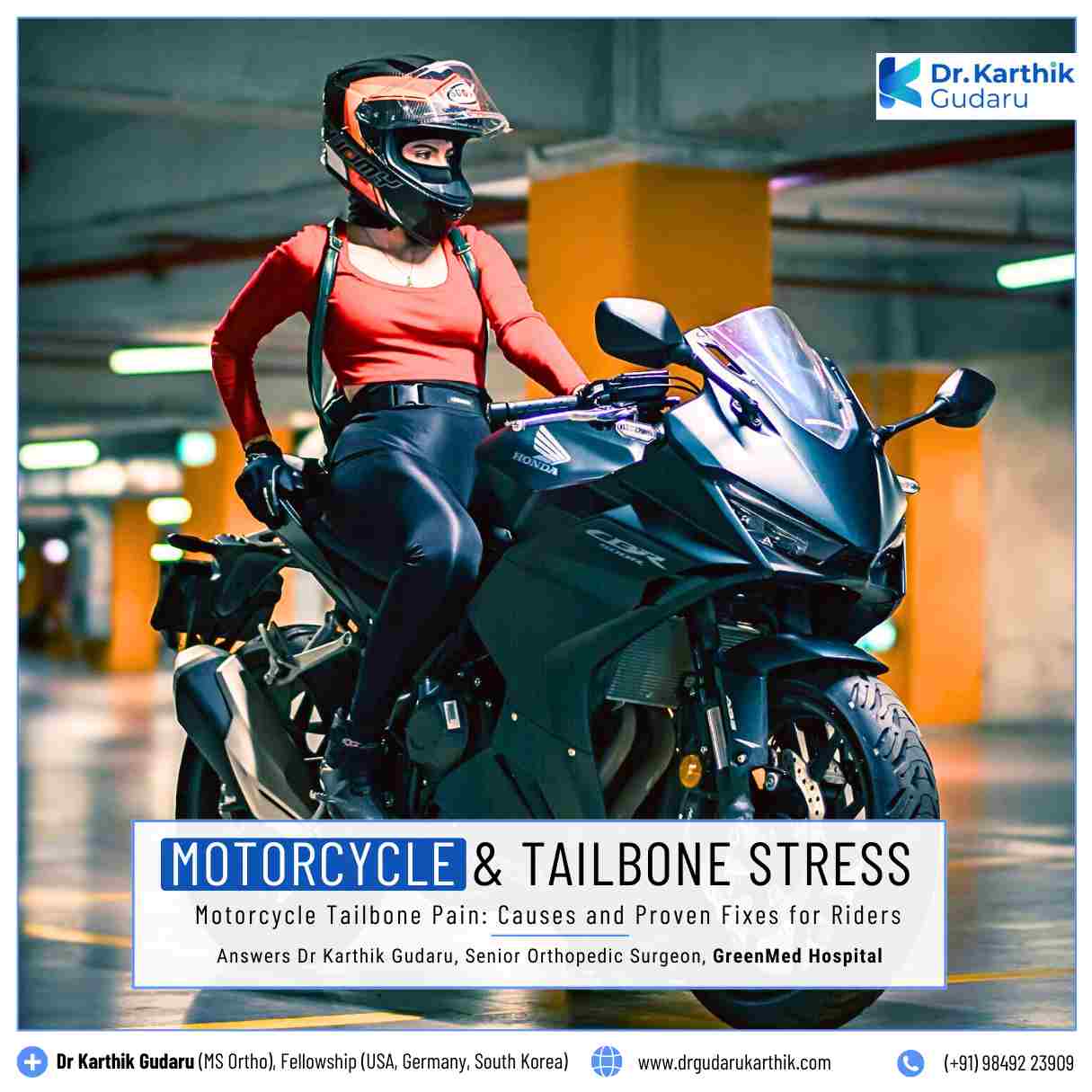
This Article is Medically Reviewed by Dr Karthik Gudaru, MS Orthopaedics, Fellowship in Computer-Assisted Navigation and Joint Replacement Surgery (Germany), HOD Orthopaedic Department, GreenMed Hospitals, Hyderabad.
Long rides on a motorcycle can be liberating, but for many riders, the experience comes with a persistent, nagging discomfort right at the base of the spine—the tailbone. This pain, often ignored in the beginning, can gradually interfere with posture, riding endurance, and even daily movement. Understanding why this happens and how to correct it is essential, especially if riding is a regular part of your lifestyle, says Dr Karthik Gudaru, a Senior Orthopaedic surgeon at and Specialist in back pain treatments in Hyderabad.
Why Does Riding a Motorcycle Put Stress on the Tailbone?
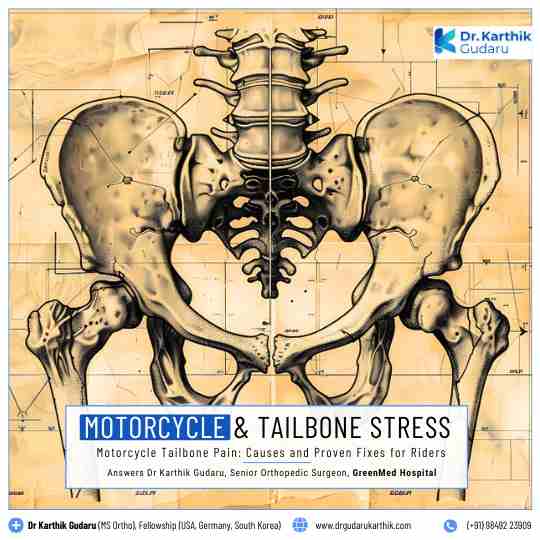
The tailbone, or coccyx, is a small but sensitive structure that bears weight when you sit—particularly when your posture is off. Motorcycle seats, especially those that are narrow, firm, or poorly cushioned, tend to concentrate pressure directly on this area. Combine that with long hours, road vibrations, and slight forward leaning, and the coccyx begins to absorb repeated micro-trauma.
Another overlooked factor is posture. Many riders unknowingly slump or tilt their pelvis backward, which shifts body weight away from the thighs and onto the tailbone. Over time, this leads to inflammation and a condition often associated with sitting pain known as coccydynia.
“Comfort on a motorcycle is never just about the machine beneath you—it is about the awareness within you. The way you sit, the way you balance, the way you respond to every vibration and shift in the road quietly determines whether the journey strengthens you or slowly wears you down. The tailbone, small and often ignored, becomes a messenger of these choices, reminding you that even freedom on the open road demands discipline in posture, respect for your body, and the wisdom to pause before pain becomes a problem. Ride long, but ride aware—because endurance is not built by pushing through discomfort, but by understanding it and correcting it before it takes control.” – Dr Karthik Gudaru, MS Orthopaedics, MBBS, Fellowship in Knee and Hip Arthroplasty (USA), Fellowship in Computer Assisted Navigation Joint Replacement Surgery (Germany)
Correcting Your Riding Posture
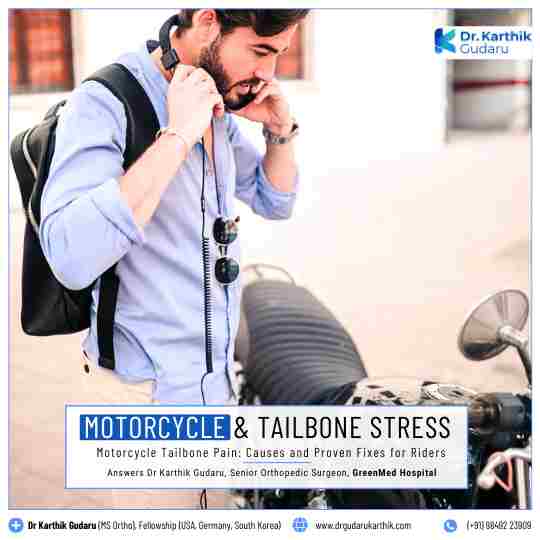
Posture is the first and most effective correction. The goal is to distribute your weight evenly across your sitting bones rather than letting it collapse onto the tailbone. Sitting upright with a neutral spine—not overly arched, not slouched—helps maintain this balance.
Your hips should be slightly tilted forward, allowing your core muscles to support your upper body instead of relying entirely on the seat. Keeping your feet firmly positioned on the pegs and your knees gently gripping the tank can also reduce pressure from the lower spine. Small posture adjustments during the ride, rather than staying rigid, can prevent continuous stress on one point.
Choosing the Right Seat and Cushioning
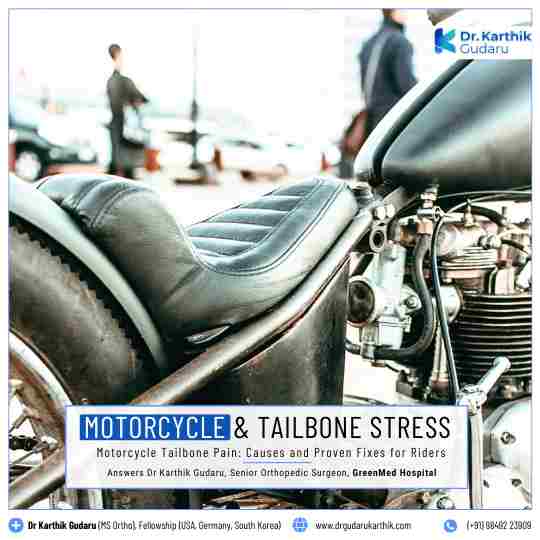
Not all motorcycle seats are designed with ergonomics in mind. If tailbone discomfort is a recurring issue, upgrading your seat can make a significant difference. Seats with better contouring distribute weight more evenly and reduce direct coccyx pressure.
Adding a gel cushion or an air-based seat pad is another practical solution. These accessories absorb road shock and vibrations while creating a buffer between your body and the hard surface beneath. Even minor improvements in cushioning can dramatically reduce cumulative stress over long rides.
Managing Ride Duration and Breaks
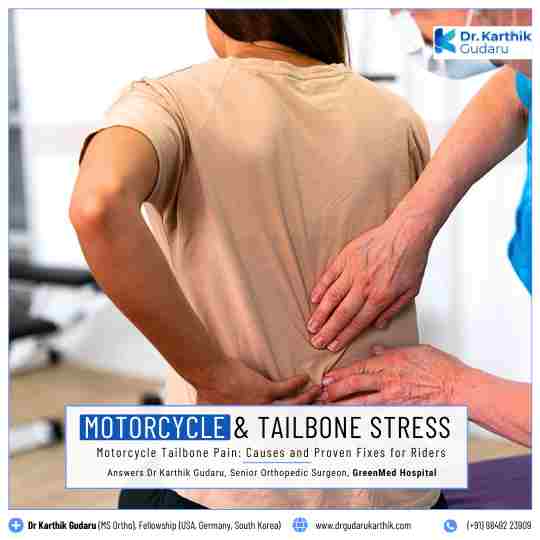
One of the biggest mistakes riders make is pushing through long distances without breaks. Continuous sitting compresses the spine and aggravates the tailbone. Taking short breaks every 45–60 minutes allows your muscles to relax and restores circulation.
Standing briefly on the foot pegs while riding (when safe to do so) can also relieve pressure from the coccyx. These micro-adjustments may seem insignificant, but they prevent prolonged strain that leads to chronic discomfort.
Strengthening Core and Lower Back Muscles
Your body plays a major role in how pressure is distributed while riding. A weak core shifts more load onto the spine and tailbone. Strengthening abdominal and lower back muscles helps support your posture naturally.
Exercises focusing on pelvic alignment, glute strength, and spinal stability can reduce the likelihood of tailbone pain. Stretching the hamstrings and hip flexors is equally important, as tightness in these areas can subtly alter your sitting posture and increase coccyx pressure.
Adjusting Motorcycle Ergonomics
Sometimes the issue isn’t just you—it’s the bike setup. Handlebar position, seat height, and foot peg placement all influence posture. If your handlebars are too far forward or too low, you’re more likely to lean excessively, shifting weight onto the tailbone.
Ensuring that your riding triangle (handlebars, seat, and foot pegs) suits your body proportions can significantly reduce strain. Even minor ergonomic adjustments can improve comfort over long distances.
When Should You See an Orthopedic Doctor?
Occasional discomfort after a long ride is one thing; persistent or worsening pain is another. If the pain in your tailbone continues even after rest, starts affecting daily sitting activities, or becomes sharp and localized, it’s time to consult a orthopedic specialist.
An orthopedic doctor can assess whether the issue is simple inflammation or something more structural, such as a coccyx injury or misalignment. If symptoms include numbness, tingling, or pain radiating into the legs, a spinal specialist may be required to rule out nerve involvement or deeper spinal issues.
Ignoring these warning signs can turn a manageable problem into a chronic condition. Early evaluation not only speeds up recovery but also helps you return to riding without long-term damage.
Tailbone stress from motorcycle riding isn’t inevitable—it’s usually the result of correctable factors. Posture, seat design, ride habits, and physical conditioning all play a role. Addressing these areas thoughtfully can transform your riding experience from painful endurance to sustained comfort.
Dr Karthik Gudaru, MS Orthopaedics, MBBS, Fellowship in Knee and Hip Arthroplasty (USA), Fellowship in Computer-Assisted Navigation Joint Replacement Surgery (Germany), is one of Hyderabad’s leading orthopaedic surgeons with an outstanding reputation for precision, innovation, and excellence in joint replacement and orthopaedic care. Widely recognised as the best knee replacement specialist in Hyderabad, he brings a deep commitment to patient-centred care and cutting-edge surgical techniques.
Dr Karthik Gudaru is currently the Senior Orthopaedic and Joint Replacement Specialist, Department of Orthopaedics at GreenMed Hospital, Srinagar Colony, Hyderabad, Assistant Professor and Consultant Orthopaedic at BIRRD Hospital (Balaji Institute of Surgery, Research and Rehabilitation for the Disabled), Tirupati and Joint Replacement & Pediatric Orthopedic Specialist at Sri Maruthi Hospitals, Tirupati.
Dr Karthik Gudaru’s Treatment Specialisation are –
Knee Joint Treatments (Including Total Knee Replacement Surgery).
Shoulder Joint Treatments (Including Total Shoulder Replacement Surgery).
Hip Joint Treatments (Including Total Hip Replacement Surgery).
Elbow Joint Treatments (Including Total Elbow Arthroscopy).
Computer-Assisted Knee Replacement Surgery.
Stem Cell Therapy for key orthopaedic treatments.
Pediatric Orthopedics Surgeon for Cerebral Palsy, Congenital Anomalies, Poliomyelitis & Metabolic Bone Diseases