

Direct Answer Summary
- Knee pain while squatting may result from patellofemoral pain, arthritis, meniscus problems, tendon irritation, muscle weakness, or restricted movement.
- Pain location, squat depth, swelling, and associated symptoms can help identify the possible cause.
- Persistent pain, locking, instability, or swelling should be evaluated by a knee specialist before continuing strenuous exercise.
This Article is Medically Reviewed by Dr Karthik Gudaru, MS Orthopaedics, Fellowship in Computer-Assisted Navigation and Joint Replacement Surgery (Germany), HOD, Orthopaedic Department, GreenMed Hospitals, Hyderabad and Senior Paediatric Orthopaedic Surgeon, Sri Maruthi Hospitals, Tirupati
Squatting is a common movement involved in exercising, lifting objects, sitting down, and getting up from a chair. However, when knee pain develops during this movement, even routine activities can become uncomfortable. Some people experience pain only while performing deep squats, while others notice discomfort when bending their knees slightly or returning to a standing position.
Knee pain during squatting does not always indicate serious joint damage. However, understanding the location, intensity, and circumstances of the discomfort can help identify whether the problem involves the kneecap, cartilage, meniscus, tendons, or surrounding muscles, shares Dr Karthik Gudaru, Senior Orthopaedic Surgeon and specialist Knee Replacement Surgeon in Hyderabad.
What Is Your Body Trying to Tell You When Your Knee Hurts During Squatting?
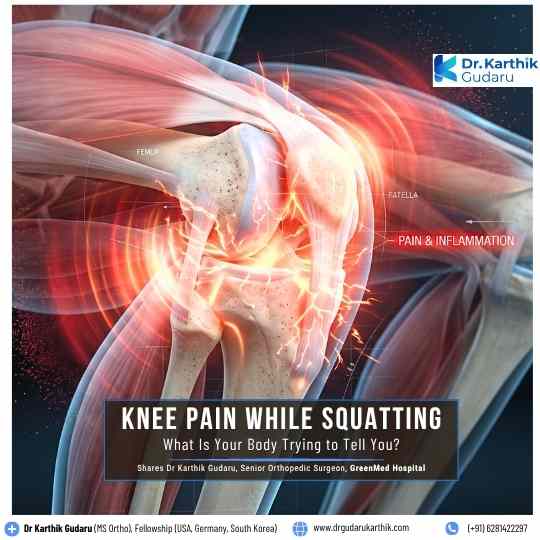
Knee pain during squatting may indicate that the joint or surrounding tissues are experiencing excessive stress, irritation, or reduced tolerance to physical activity. Squatting requires coordination between the quadriceps, hamstrings, hip muscles, ankle movement, and knee joint.
As the knee bends, the kneecap moves against the thigh bone, and pressure within the joint increases. Deeper squats place greater demands on the knee, particularly when performed with additional weight.
Pain may develop when the movement exceeds the knee’s current capacity, when muscles are not providing adequate control, or when an underlying joint condition is present. Identifying the specific cause is important because different knee problems require different treatment approaches.
“Knee pain is a symptom, not a diagnosis. Understanding its cause is the first step toward appropriate treatment.” Says Sr Orthopedic Surgeon for Knee Joint Treatment in Hyderabad, Dr Karthik Gudaru.
Why Does the Knee Hurt During Deep Squats?
Deep squatting increases knee bending and places additional pressure on the joint surfaces. For some individuals, this movement may aggravate existing irritation or discomfort.
Several factors can contribute to deep-squat pain, including:
- Patellofemoral pain involving the kneecap and thigh bone.
- Knee osteoarthritis affecting the joint cartilage.
- Meniscus irritation or injury.
- Quadriceps or patellar tendon problems.
- Restricted ankle movement or reduced hip mobility.
- Muscle weakness, fatigue, or sudden increases in exercise intensity.
The discomfort may become more noticeable when squatting with heavy weights, performing repeated repetitions, or exercising without adequate preparation.
What Does the Location of Knee Pain Indicate?
The location of discomfort can provide useful clues about the structures involved, although it cannot confirm a diagnosis on its own.
| Pain location | Possible causes |
|---|---|
| Front of the knee | Patellofemoral pain, kneecap arthritis, or tendon irritation. |
| Inner knee | Medial meniscus problems, arthritis, or ligament irritation. |
| Outer knee | Lateral meniscus problems, arthritis, or irritation of surrounding tissues. |
| Behind the knee | Joint swelling, arthritis, or irritation involving posterior knee structures. |
| Below the kneecap | Patellar tendon irritation or other localised conditions. |
A knee surgeon evaluates these symptoms alongside physical examination findings, movement patterns, medical history, and imaging when required.
Can Muscle Weakness or Poor Squatting Technique Cause Knee Pain?
Yes. Muscle weakness, fatigue, and movement-related factors can contribute to knee discomfort during squatting. The quadriceps help control knee bending, while the hip muscles support alignment and stability. When these muscles are weak or fatigued, the knee may experience increased stress during repeated movements. Limited ankle mobility can also affect squat mechanics. For example, difficulty moving the ankle forward may cause the heels to lift or the body to shift during the movement.
However, knee pain should not automatically be blamed on incorrect technique. Arthritis, meniscus problems, tendon irritation, and other conditions can also produce similar symptoms.
Does Knee Pain During Squatting Mean You Have Arthritis?
Not necessarily. Knee pain during squatting can occur in people with or without arthritis. Osteoarthritis involves changes in the joint cartilage and surrounding structures. Symptoms may include pain during movement, stiffness after rest, reduced flexibility, and difficulty performing activities such as climbing stairs or getting up from a chair.
Some individuals experience discomfort primarily during deep knee bending, while others notice symptoms during ordinary walking or standing. A knee specialist may recommend an examination and appropriate imaging to determine whether arthritis is contributing to the discomfort.
When Should You Stop Squatting and Consult a Knee Surgeon?
Temporary discomfort after strenuous exercise may improve with rest and activity modification. However, certain symptoms require medical evaluation rather than continued exercise.
Seek medical attention if you experience:
- Persistent or worsening knee pain.
- Significant swelling after exercise or an injury.
- Repeated episodes of the knee giving way.
- Painful catching or difficulty bending the knee.
- A knee that becomes physically locked and cannot move normally.
- Difficulty bearing weight after an injury.
Sudden severe pain, substantial swelling, inability to bear weight, or a hot, red knee accompanied by fever requires urgent medical assessment.
How Can Knee Pain During Squatting Be Managed?
Treatment depends on the underlying cause, severity, and individual activity requirements. A knee surgeon may recommend temporarily reducing deep squats, heavy lifting, or movements that repeatedly aggravate symptoms. Physiotherapy can help improve quadriceps strength, hip control, flexibility, and movement coordination.
For some patients, appropriate exercise modification and rehabilitation are sufficient to improve symptoms. Others may require medication, additional investigations, or treatment for an underlying joint condition. Surgery is not necessary for every patient experiencing knee pain during squatting. The decision depends on the diagnosis, severity of symptoms, response to conservative treatment, and functional limitations.
Knee pain while squatting is a symptom that deserves attention, particularly when it persists, worsens, or interferes with everyday activities. The discomfort may arise from the kneecap, cartilage, meniscus, tendons, muscles, or movement-related factors. Understanding where the pain occurs, when it develops, and whether other symptoms accompany it can help guide appropriate evaluation.
As a general principle, do not force your knee through painful deep squats. A proper assessment can help identify the underlying problem and determine whether exercise modification, physiotherapy, medication, or further treatment is appropriate.

Dr Karthik Gudaru, MS Orthopaedics, MBBS, Fellowship in Knee and Hip Arthroplasty (USA), Fellowship in Computer-Assisted Navigation Joint Replacement Surgery (Germany), is one of Hyderabad’s leading orthopaedic surgeons with an outstanding reputation for precision, innovation, and excellence in joint replacement and orthopaedic care. Widely recognised as the best knee replacement specialist in Hyderabad, he brings a deep commitment to patient-centred care and cutting-edge surgical techniques.
Dr Karthik Gudaru is currently the Senior Orthopaedic and Joint Replacement Specialist, Department of Orthopaedics at GreenMed Hospital, Srinagar Colony, Hyderabad; Assistant Professor and Consultant Orthopaedic at BIRRD Hospital (Balaji Institute of Surgery, Research and Rehabilitation for the Disabled), Tirupati; and Joint Replacement & Pediatric Orthopaedic Specialist at Sri Maruthi Hospitals, Tirupati.
Dr Karthik Gudaru’s treatment specialisations –
Knee Replacement Surgery.
Shoulder Replacement Surgery.
Hip Joint Treatments.
Elbow Fracture.
Computer-Assisted Knee Replacement Surgery.
Stem Cell Therapy for key orthopaedic treatments.
Specialist Orthopaedics Treatment for Children (Pediatric orthopaedics)
Arthritis Treatment in Hyderabad and Telangana
Hospital Affiliations
GreenMed Hospital, Orthopaedic OPD, 8-3-833/71, Srinagar Colony Main Rd, Kamalapuri Colony, Banjara Hills, Hyderabad, Telangana
Durgabai Deshmukh Hospital, Vidyanagar, Hyderabad
Sri Maruthi Hospitals, OPD, 19-3-30/C1, Near RTC Bus Stand, Kennedy Nagar, Tirupati, 517501
BIRRD Hospital, Tirupati (Consultant & Asst. Professor)
Education and Affiliation
MBBS, Telangana State Medical Council, Registration No TSMC/FMR/16001
MS Orthopaedics, Tamil Nadu Medical Council, Registration No: 119525
Knee & Hip Arthroplasty Fellowship: Dartmouth Hospital, USA (2018)
Robotic & Computer-Assisted Joint Replacement Fellowship: Asklepios Hospital, Germany (2018)
AO Trauma & Emergency Orthopaedic Care Fellowship: Guro National Hospital, South Korea (2019–2020)
Spinal Surgery Observer Training: Yonsei University, South Korea (2015)
Medical Publications & Clinical Studies