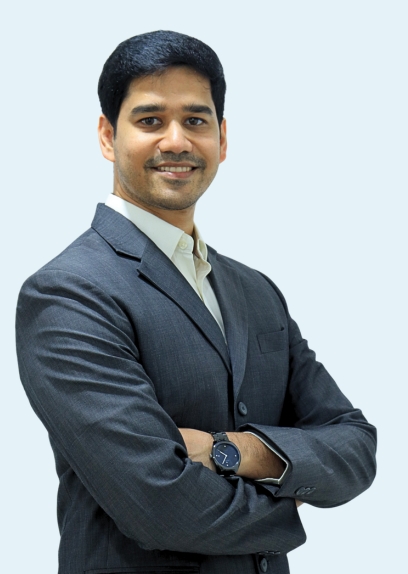
MBBS, MS Orthopaedics, Fellowship in Knee and Hip Arthroplasty (USA), Fellowship in Computer Assisted Navigation Joint Replacement Surgery (Germany). Dr Karthik Gudaru is currently the Senior Oprthopedic and Joint Replacement Specialistlist, Department of Orthopedics at GreenMed Hospital, Srinagar Colony, Hyderabad & Joint Replacement & Pediatric Orthopedic Specialist at Sri Maruthi Hospitals, Tirupati, Andhra Pradesh
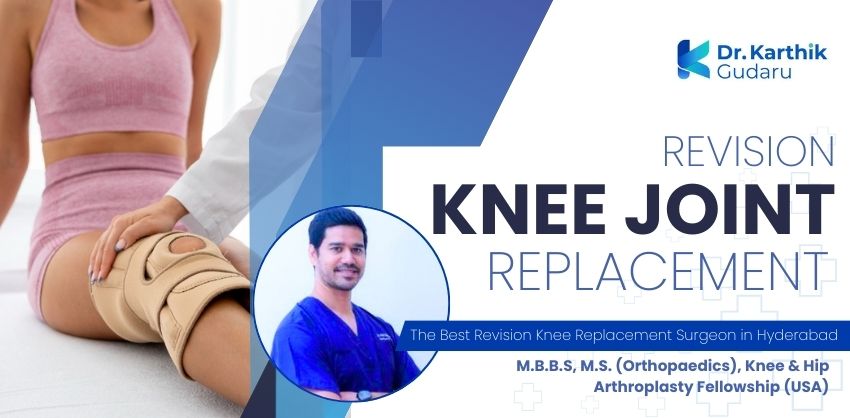
Dr Karthik Gudaru is a senior orthopedic and joint replacement surgeon with deep expertise in managing complex knee joint conditions. He is widely known for precision-focused orthopedic care and specializes in advanced knee preservation therapies and modern joint replacement procedures that aim to relieve pain and restore natural movement. With formal training in robotic and computer-assisted surgical systems and extensive experience in complex orthopedic practice, he provides comprehensive knee joint treatment services in Hyderabad.
Dr Gudaru’s approach focuses on restoring mobility, improving functional independence, and enhancing quality of life through accurate diagnosis, evidence-based treatment planning, and minimally invasive surgical techniques wherever appropriate.
Over his career, he has performed more than 12,000 orthopedic procedures, including over 4,000 successful knee replacement surgeries, making him one of the most trusted specialists for knee joint treatments and surgeries in Hyderabad.
Comprehensive knee joint care under Dr Karthik Gudaru includes detailed evaluation, structured rehabilitation, and advanced computer-assisted procedures designed to correct joint damage and support long-term mobility for patients across Telangana.
Revision Knee Replacement is performed when a previous knee replacement fails, wears out, becomes loose, or develops complications [3]. Unlike an initial joint replacement, a revision is a highly complex secondary operation that takes place in a structurally altered environment.
The primary goal of this advanced surgery is to meticulously remove failing or unstable implants while protecting the surrounding bone channels. Because the underlying bone is often degraded or thinned out around a loose implant, Dr. Karthik Gudaru focuses heavily on structural joint preservation, using specialized corrective hardware to restabilize the limb and restore pain-free movement.
Implants can break down or lose stability due to several distinct biological and mechanical factors. Identifying the exact root cause of the failure is what allows Dr. Gudaru to plan a successful secondary reconstruction.
He evaluates several critical failure mechanisms before initiating a corrective plan:
To ensure search engines score this page with maximum semantic uniqueness, this comparative breakdown focuses entirely on structural salvage, bone grafting, and component constraints — medical topics that do not exist on a primary surgery page.
| Complex Reconstructive Challenge | Conventional Revision Approaches | Dr. Karthik Gudaru’s Advanced Corrective Strategy |
|---|---|---|
| Old Implant Removal | Using standard force tools that can crack or shatter fragile, thinning bone beds during extraction. | Controlled Explantation Techniques that carefully isolate the cement line, sliding the old hardware out safely. |
| Skeletal Bone Deficits | Filling major bone gaps with excessive layers of standard bone cement, which can weaken over time. | Structural Titanium Augments & Grafts to physically rebuild missing segments of the femur or tibia. |
| Compromised Ligaments | Using standard implants that rely on the patient's damaged native ligaments for stability. | Semi-Constrained & Hinged Systems that have built-in mechanical support to keep the knee perfectly stable. |
| Navigating Old Scar Lines | Making new incisions that intersect old scars, which can restrict local blood flow and delay skin healing. | Anatomic Landmark Tracking that utilizes the exact same previous incision path to protect skin vitality. |
| Post-Surgical Bracing | Relying on generic leg wraps that allow accidental twisting movements during early bone healing. | Calibrated Range-of-Motion Braces that lock out harmful rotation while allowing safe, straight leg flexion. |
Dr Karthik Gudaru says, "Our primary focus during a Revision Knee Replacement is saving your remaining skeletal structure. By anchoring specialized stems deep inside the healthy bone channels and using structural metal augments, we can completely bypass missing bone areas and give the patient a rock-solid foundation." - Dr Karthik Gudaru, Specialist Knee Replacement Orthopaedic Surgeon, Hyderabad
Because a revision involves extracting old hardware and frequently rebuilding sections of bone, the healing milestones follow a carefully protective pathway designed to allow bone grafts to fuse securely with the new reconstructive components.
Structural Integrity Diagnostic] ➔ [Implant Extraction & Bone Rebuilding] ➔ [Calibrated Brace Loading] ➔ [Targeted Muscle Stabilization]
Patients begin careful, non-twisting bed mobility drills and controlled, zero-torsion standing shifts under strict orthopedic physical therapy supervision.
Focus centers entirely on careful wound healing, systematic reduction of internal joint swelling, and gradual extension exercises within a locked frame.
Progressive weight-bearing is carefully introduced as digital X-rays confirm that the bone grafts or titanium augments are integrating with the native skeleton.

Years of focused experience in knee treatmetments and knee Replacement surgeries with consistent, successful outcomes
Every patient receives a tailored care path based on joint condition, lifestyle, and age.

 `
`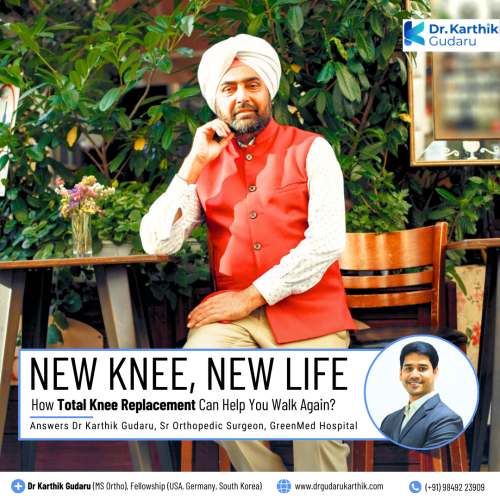
Modern implants and surgical techniques have made recovery faster and outcomes more successful, giving patients a chance to reclaim an active lifestyle, says Dr Karthik Gudaru, who is a senior orthopaedic surgeon and one of the best total knee replacement surgeons in Hyderabad and Telangana.
View More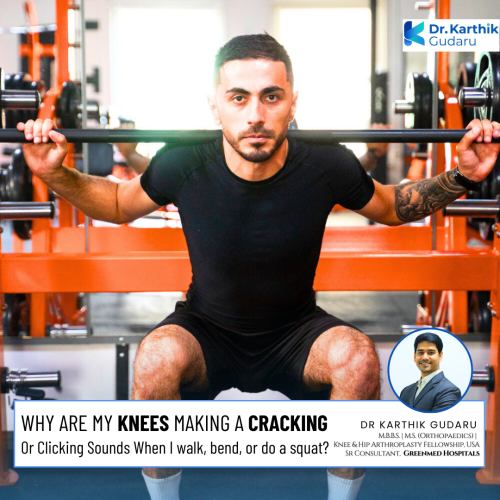
Why are my Knees making cracking sounds when I walk or bend? Answers Dr Karthik Gudaru, a senior orthopaedic doctor in Hyderabad, for knee replacement surgeries
View More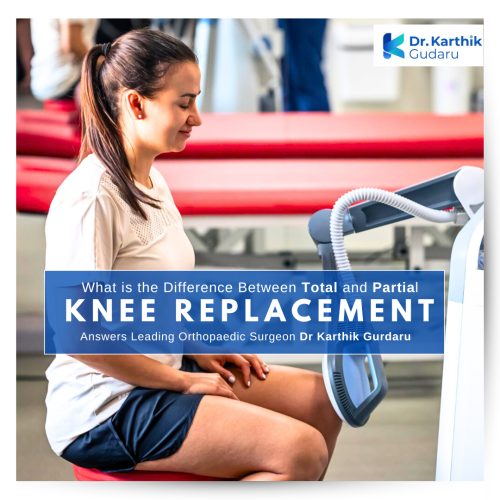
What is the difference between Total and Partial Knee Replacement? Answers Dr Karthik Gudaru, who is one of the best knee replacement surgeons in Hyderabad
View More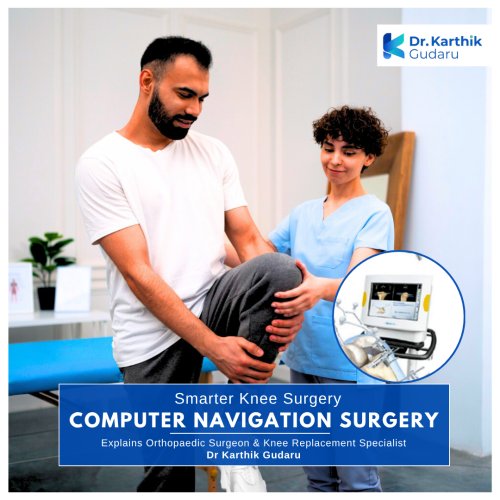
Computer navigation knee replacement surgery offers less pain, faster recovery, explains Dr Karthik Gudaru, a leading orthopaedic surgeon and one of the best computer navigation assisted knee joint surgeons in Hyderabad and India.
View More
Recognizing the right time for surgery can make all the difference in restoring mobility, reducing pain, and improving quality of life says Dr Karthik Gudaru, orthopaedic surgeon
View MoreFrequently Asked QuestionsPatients across Telangana facing failed joint procedures seek out Dr Karthik Gudaru because of his advanced skill in managing compromised skeletal structures. Operating at GreenMed Hospital in Hyderabad, he treats Revision Knee Replacement Surgery as a complex structural reconstruction rather than a simple device change. His extensive experience in controlled explantation ensures that failing hardware is removed safely without fracturing fragile bone beds, making him a trusted choice for Revision Knee Replacement Surgery.
During Revision Knee Replacement Surgery at GreenMed Hospital in Hyderabad, Telangana, Dr Karthik Gudaru avoids the unsafe practice of filling large skeletal gaps with thick layers of standard bone cement. Instead, he utilizes advanced structural titanium augments and specialized bone grafting techniques to physically rebuild missing segments of the femur and tibia. This advanced approach during Revision Knee Replacement Surgery anchors custom modular sleeves deep within healthy bone channels, creating a rock-solid, permanent foundation.
The recovery pathway after Revision Knee Replacement Surgery is highly protective to ensure that bone grafts and titanium components fuse perfectly with your native skeleton. Rather than aggressive early walking, Dr Karthik Gudaru implements a calibrated range-of-motion brace protocol at GreenMed Hospital in Hyderabad to block harmful joint rotation. Under strict supervision, patients begin non-twisting mobility drills within 24 hours of Revision Knee Replacement Surgery, transitioning to progressive weight-bearing around weeks four to six as healing is confirmed via digital scans.
You should schedule a diagnostic evaluation for Revision Knee Replacement Surgery if your existing artificial joint begins to slip, buckle, or cause deep, rubbing pain. At GreenMed Hospital in Hyderabad, Telangana, Dr Gudaru recommends investigating for a Revision Knee Replacement Surgery if digital imaging shows mechanical loosening, or if internal plastic spacers have worn down and triggered bone loss. Addressing a failing implant early prevents severe structural degradation and protects the surrounding leg tissue from irreversible damage.