

Key Clinical Takeaways:
- Osteoarthritis: Leading cause in adults 50+, marked by morning stiffness lasting <30 minutes.
- Sedentary desk strain: Very common among IT employees in Gachibowli and HITEC City.
- Urgent consultation required if the knee locks, swells rapidly within 2 hours, or prevents walking.
Knee pain is primarily caused by degenerative cartilage wear (Osteoarthritis), acute ligament tears (ACL/MCL), or meniscus cushioning damage from twists, sports, or repetitive stair climbing. In Hyderabad, lifestyle factors such as high-rise stair usage, domestic kneeling, and rapid metabolic shifts frequently trigger flare-ups. While mild sprains resolve with physical therapy and regenerative PRP, persistent pain, joint locking, or inability to bear weight warrants urgent orthopedic evaluation to prevent permanent joint deterioration.
Knee pain is often associated with an obvious injury such as a fall, sports accident, or sudden twist. But what if your knee starts hurting without any injury at all? Persistent or recurring knee pain can develop gradually and may be linked to changes inside the joint, surrounding muscles, or everyday movement patterns.
Understanding the underlying cause is important because treating knee pain effectively starts with identifying what is actually causing it shares Dr Karthik Gudaru, Senior Orthopaedic Surgeon and a Specialist Total Knee Replacement surgeon in Hyderabad, Tirupati (Telangana), Vijayawada, and Guntur (Andhra Pradesh).
Could Knee Pain Develop Without an Injury?
Yes. Knee pain can occur without a specific injury because several conditions develop gradually over time. Age-related cartilage wear, muscle weakness, inflammation, alignment problems, excess strain, and certain medical conditions can all contribute to knee discomfort.
Pain that appears while walking, climbing stairs, standing for long periods, or getting up from a chair should not automatically be dismissed as normal ageing.
“Knee pain does not always begin with an injury; sometimes, the joint has been quietly changing long before the pain appears.” Says Senior Orthopedic Surgeon for Knee Replacement in Hyderabad, Dr Karthik Gudaru.
Osteoarthritis Can Develop Gradually
One of the common causes of knee pain without a clear injury is osteoarthritis. The protective cartilage inside the knee can gradually wear down, resulting in stiffness, discomfort, swelling, and reduced movement.
Symptoms may initially appear after prolonged activity and can become more noticeable over time. In advanced cases, pain may occur even during routine activities or at rest.
Muscle Weakness Can Increase Knee Stress
The muscles surrounding the knee, particularly the quadriceps and hamstrings, help support and stabilise the joint. When these muscles are weak, everyday movements can place greater stress on the knee.
A structured strengthening programme may help improve muscle support and joint function when muscle weakness contributes to symptoms.
Poor Alignment Can Affect the Joint
Changes in leg alignment can influence how forces are distributed across the knee. Conditions such as bow legs or knock knees can place greater pressure on specific areas of the joint. Over time, uneven loading may contribute to pain and cartilage wear, particularly when combined with other risk factors.
Inflammation Can Cause Pain and Stiffness
Inflammatory conditions can cause knee pain even when there has been no injury. Rheumatoid arthritis and other inflammatory joint conditions may cause swelling, warmth, stiffness, and discomfort. Persistent swelling or stiffness, particularly when several joints are affected, warrants appropriate medical evaluation.
Overuse Can Be an Invisible Trigger
You do not have to experience a dramatic injury to put excessive stress on your knees. Suddenly increasing walking, running, exercise, stair climbing, or other physical activity can cause overuse-related discomfort. Repeated stress may affect tendons, muscles, or other structures around the knee.
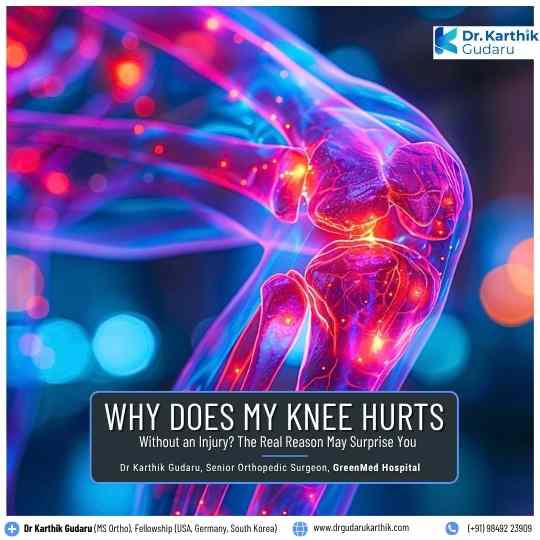
Previous Problems May Resurface
Sometimes current knee pain is connected to an old problem rather than a recent injury. Previous ligament damage, cartilage problems, surgery, or an earlier fracture can alter how the joint functions and potentially contribute to symptoms later. This is why a complete medical history can be important when evaluating unexplained knee pain.
Knee Pain Reasons Matrix (Symptom-to-Cause Diagnostic Guide)
| Condition | Key Symptoms | Hyderabad Demographics | Primary Treatment Pathway | Surgical Need |
|---|---|---|---|---|
| Knee Osteoarthritis (Wear & Tear) | Deep aching inside jointMorning stiffness lasting <30 minsGrating or crackling sensation (crepitus)Pain worse after prolonged walking | Highly prevalent across Hyderabad due to genetic predisposition, dietary shifts, and prolonged floor sitting or high apartment stair use without lifts. | Grade 1-2: Physio, PRP therapy, lifestyle change; Grade 3-4: Hyaluronic acid or Robotic Partial/Total Knee Replacement. | High (if advanced) |
| Meniscus & Ligament Tears (ACL / PCL) | Sudden “pop” sound during twisting motionImmediate joint swelling & effusionKnee giving way or locking mid-strideSharp joint line tenderness | Frequent among Hyderabad techies participating in weekend box-cricket, turf football, or sudden motorbike skidding in Hyderabad traffic. | MRI diagnostic evaluation, Arthroscopic keyhole repair, or hamstring graft ACL reconstruction with rapid rehab. | Moderate |
| Patellofemoral Pain (“Moviegoer’s Knee”) | Aching pain around or behind kneecapSharp pain when sitting for >1 hour with bent kneesDiscomfort while climbing down stairsMild swelling after gym squats | Extremely widespread in Hitec City, Gachibowli, and Madhapur due to 9–11 hour sitting shifts with weak VMO (quadriceps) muscles. | Ergonomic workstation adjustment, VMO strengthening exercises, patellar taping, and hamstring stretching. | Rare |
| Patellar Tendinitis (“Jumper’s Knee”) | Point tenderness just below kneecapBurning pain during jumping or deep squatsStiffness after intense workout | Common in Hyderabad fitness enthusiasts training on hard concrete roads or intensive apartment stair climbing. | Eccentric decline squats, shockwave therapy, ultrasound-guided PRP injection, relative rest. | Rare |
When Knee Pain Needs Medical Attention?
Knee pain that persists, worsens, repeatedly returns, or interferes with everyday activities should be evaluated by an orthopaedic specialist. Swelling, significant stiffness, instability, difficulty bearing weight, or reduced range of motion are additional reasons to seek professional assessment.
The appropriate evaluation may include a physical examination and, when necessary, imaging such as X-rays or MRI to identify the underlying problem.
Treatment Depends on the Cause
There is no single treatment for unexplained knee pain. Depending on the diagnosis, management may include activity modification, physiotherapy, muscle strengthening, weight management, medication, injections, or other interventions.
Advanced joint damage may require surgical options such as osteotomy or partial or total knee replacement. The treatment should be selected according to the condition of the knee and the individual’s symptoms and functional requirements.
Knee pain without an obvious injury should not automatically be ignored. It may be the first sign of gradual cartilage wear, muscle weakness, inflammation, alignment issues, or overuse. Finding the underlying cause early can help guide appropriate treatment and may help prevent the problem from affecting mobility and quality of life.
Frequently Asked Questions

Dr Karthik Gudaru, MS Orthopaedics, MBBS, Fellowship in Knee and Hip Arthroplasty (USA), Fellowship in Computer-Assisted Navigation Joint Replacement Surgery (Germany), is one of Hyderabad’s leading orthopaedic surgeons with an outstanding reputation for precision, innovation, and excellence in joint replacement and orthopaedic care. Widely recognised as the best knee replacement specialist in Hyderabad, he brings a deep commitment to patient-centred care and cutting-edge surgical techniques.
Dr Karthik Gudaru is currently the Senior Orthopaedic and Joint Replacement Specialist, Department of Orthopaedics at GreenMed Hospital, Srinagar Colony, Hyderabad, Assistant Professor and Consultant Orthopaedic at BIRRD Hospital (Balaji Institute of Surgery, Research and Rehabilitation for the Disabled), Tirupati and Joint Replacement & Pediatric Orthopedic Specialist at Sri Maruthi Hospitals, Tirupati.
Dr Karthik Gudaru’s Treatment Specialisation are –
Knee Joint Treatments (Including Total Knee Replacement Surgery).
Shoulder Joint Treatments (Including Total Shoulder Replacement Surgery).
Hip Joint Treatments (Including Total Hip Replacement Surgery).
Elbow Joint Treatments (Including Total Elbow Arthroscopy).
Computer-Assisted Knee Replacement Surgery.
Stem Cell Therapy for key orthopaedic treatments.
Pediatric Orthopedics Surgeon for Cerebral Palsy, Congenital Anomalies, Poliomyelitis & Metabolic Bone Diseases