

Key Clinical Takeaways as per the Orthopaedic Surgeon
- Uneven shoe wear may reflect differences in gait, foot position or leg alignment.
- Mild asymmetry can be part of normal childhood development.
- Persistent changes with pain or walking difficulties should be assessed.
This Article is Medically Reviewed by Dr Karthik Gudaru, MS Orthopaedics, Fellowship in Computer-Assisted Navigation and Joint Replacement Surgery (Germany), HOD, Orthopaedic Department, GreenMed Hospitals, Hyderabad and Senior Paediatric Orthopaedic Surgeon, Sri Maruthi Hospitals, Tirupati
If your child’s shoes consistently wear out more on one side, it may be more than a footwear issue. Uneven shoe wear can sometimes reflect the way a child walks, stands or distributes weight across their feet and legs. While mild differences are common during growth, noticeable or persistent patterns may warrant closer attention, shares Dr Karthik Gudaru, Specialist Paediatric Orthopaedics Surgeon and Knee Replacement specialist in Hyderabad, Tirupati (Telangana), Vijayawada, and Guntur (Andhra Pradesh).
What Causes Uneven Shoe Wear in Children?
Children develop rapidly, and their walking patterns can change as their muscles, bones and joints mature. Uneven shoe wear may occur because of foot position, gait patterns, flat feet, leg alignment or differences in how weight is distributed while walking or running.
Sometimes, the cause is simply the child’s natural walking style. In other cases, repeated uneven wear can be a clue that the child’s lower limbs are not moving or aligning as expected.
“Sometimes, the wear on a child’s shoes can offer an early clue to the way their feet and legs are working together.” Says Dr Karthik Gudaru one of the highly experienced Senior Paediatric Orthopaedic Surgeons in Hyderabad.
Can Flat Feet Affect How a Child Walks?
Flat feet are common in children, particularly when the foot is still developing. Flexible flat feet may not cause any symptoms and often require no treatment.
However, when flat feet are associated with pain, tiredness, difficulty with physical activities or changes in walking, an assessment by a paediatric orthopaedic specialist can help determine whether further attention is needed.
Can Bow Legs or Knock Knees Cause Uneven Wear?
Leg alignment naturally changes throughout childhood. Bow legs and knock knees can therefore be part of normal development at certain ages.
If the alignment is significantly different between the two legs, persists beyond the expected developmental stage or appears to be worsening, it may affect the child’s walking pattern and contribute to uneven pressure on footwear.
When Should Parents Consult a Paediatric Orthopaedic Surgeon?
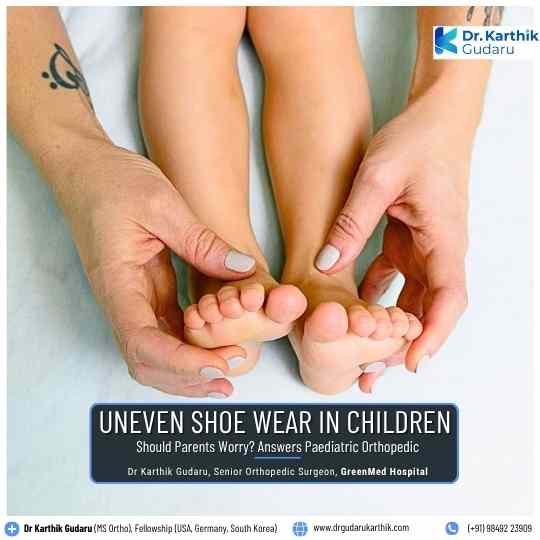
Uneven shoe wear by itself does not necessarily indicate a medical problem. Parents should pay closer attention when it occurs with persistent pain, limping, frequent tripping, difficulty running, reduced physical activity or an obvious difference between the two legs or feet.
A paediatric orthopaedic surgeon can examine the child’s gait, posture, foot position and limb alignment to determine whether the pattern is simply developmental or requires further evaluation.
How Can a Child’s Walking Pattern Be Evaluated?
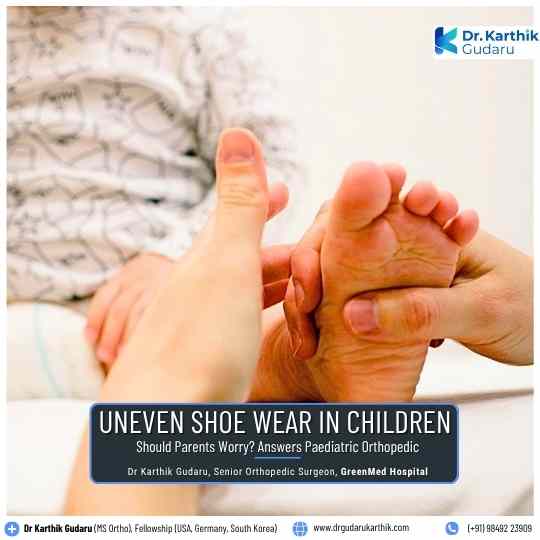
Assessment generally involves observing how the child stands and walks and examining the movement of the feet, knees and hips. The specialist may also evaluate joint flexibility, muscle strength and limb alignment.
Depending on the findings, imaging or other investigations may be recommended. Not every child with uneven shoe wear needs scans or treatment.
Why Should Parents Avoid Assuming That New Shoes Will Solve the Problem?
Replacing worn footwear is necessary, but new shoes may not address the reason behind an unusual wear pattern. If the same area of the shoe repeatedly wears down, consider whether the child’s walking mechanics are contributing.
Focus on understanding the underlying pattern rather than trying to correct the shoe itself. Uneven shoe wear is often a normal variation in growing children, but persistent or pronounced wear can sometimes provide a clue about gait, foot position or leg alignment. Parents should consider the child’s walking pattern, symptoms and overall development, rather than judging the condition from the shoes alone.
If unusual shoe wear is accompanied by pain, limping, frequent tripping or noticeable alignment changes, a paediatric orthopaedic evaluation can provide appropriate guidance.

Dr Karthik Gudaru, MS Orthopaedics, MBBS, Fellowship in Knee and Hip Arthroplasty (USA), Fellowship in Computer-Assisted Navigation Joint Replacement Surgery (Germany), is one of Hyderabad’s leading orthopaedic surgeons with an outstanding reputation for precision, innovation, and excellence in joint replacement and orthopaedic care. Widely recognised as the best knee replacement specialist in Hyderabad, he brings a deep commitment to patient-centred care and cutting-edge surgical techniques.
Dr Karthik Gudaru is currently the Senior Orthopaedic and Joint Replacement Specialist, Department of Orthopaedics at GreenMed Hospital, Srinagar Colony, Hyderabad, Assistant Professor and Consultant Orthopaedic at BIRRD Hospital (Balaji Institute of Surgery, Research and Rehabilitation for the Disabled), Tirupati and Joint Replacement & Pediatric Orthopedic Specialist at Sri Maruthi Hospitals, Tirupati.
Dr Karthik Gudaru’s Treatment Specialisation are –
Knee Joint Treatments (Including Total Knee Replacement Surgery).
Shoulder Joint Treatments (Including Total Shoulder Replacement Surgery).
Hip Joint Treatments (Including Total Hip Replacement Surgery).
Elbow Joint Treatments (Including Total Elbow Arthroscopy).
Computer-Assisted Knee Replacement Surgery.
Stem Cell Therapy for key orthopaedic treatments.
Pediatric Orthopedics Surgeon for Cerebral Palsy, Congenital Anomalies, Poliomyelitis & Metabolic Bone Diseases