

Orthopaedic Surgeon’s Direct Answer Summary
- Driving can strain your back through prolonged sitting and poor posture.
- Seat adjustment helps, but it may not be the only factor.
- Persistent or radiating pain should be medically evaluated.
This Article is Medically Reviewed by Dr Karthik Gudaru, MS Orthopaedics, Fellowship in Computer-Assisted Navigation and Joint Replacement Surgery (Germany), HOD, Orthopaedic Department, GreenMed Hospitals, Hyderabad and Senior Paediatric Orthopaedic Surgeon, Sri Maruthi Hospitals, Tirupati
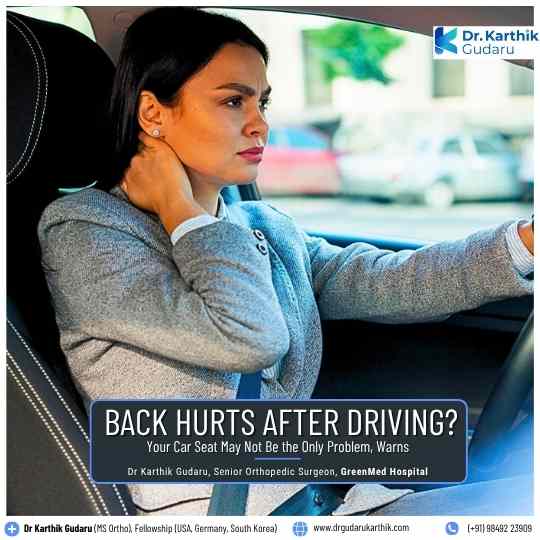
Driving for long periods can leave your back feeling stiff, sore, or uncomfortable. Many people immediately blame the car seat, but prolonged sitting is only one possible reason. Your driving posture, steering position, road conditions, muscle fatigue, and an existing spinal problem can also contribute to back pain.
Understanding what happens to your back while driving can help you identify possible triggers and make simple changes to reduce unnecessary strain, shares Dr Karthik Gudaru, Sr Orthopaedics Surgeon and Spine and Back specialist in Hyderabad, Tirupati (Telangana), Vijayawada, and Guntur (Andhra Pradesh).
Why Does Your Back Hurt After Driving?
Driving keeps the body in a relatively fixed position for an extended period. Unlike walking or standing, sitting limits natural movement and can place continuous stress on the muscles supporting the spine.
The problem may become more noticeable during long journeys, particularly when there are few opportunities to change position or stretch. Repeated driving for work can also make this discomfort more frequent.
“When back pain repeatedly follows driving, look beyond the seat and consider what your posture, movement, and spine are telling you.” Opines Dr Karthik Gudaru, one Hyderabad’s most experienced surgeons for Spine and back treatment.
Can Your Driving Posture Strain Your Back?
Yes. Leaning too far forward, slouching, twisting toward the steering wheel, or sitting too far away from the pedals can increase strain on the back.
Your body should remain comfortably supported while allowing you to reach the steering wheel and pedals without excessive stretching. Maintaining a neutral position can reduce unnecessary stress during longer drives.
Is Your Car Seat Really the Problem?
Your seat can contribute to discomfort, but it may not be the entire explanation. A poorly adjusted seat can leave your lower back unsupported or force you to maintain an awkward position.
Seat height, distance from the pedals, backrest angle, and lumbar support can all influence comfort. However, even a well-adjusted seat cannot completely eliminate the effects of prolonged sitting.
How Does Long-Distance Driving Affect the Spine?
Long periods of sitting can increase pressure on the lower back and reduce opportunities for movement. When muscles remain in one position for too long, they can become fatigued and stiff.
Frequent long-distance driving may therefore aggravate existing back problems or contribute to recurring discomfort, particularly when combined with poor posture and limited breaks.
Can Road Vibrations Make Back Pain Worse?
Continuous exposure to road vibrations and repeated bumps can contribute to discomfort, especially during long journeys. This may be more noticeable on poorly maintained roads or when driving over uneven surfaces. While vibrations are not necessarily the primary cause of back pain, they can add to the physical stress experienced during prolonged driving.
What Other Factors Can Cause Back Pain While Driving?
Back pain after driving can have several possible causes. Muscle strain, reduced flexibility, previous injuries, poor posture, weak core muscles, and existing spinal conditions may all play a role. Pain that consistently occurs after driving should therefore not automatically be attributed to the car seat. Understanding the underlying cause is important when discomfort keeps returning.
How Can You Reduce Back Strain While Driving?
Adjust your seat so your back is supported and your knees remain comfortably positioned. Keep the steering wheel at a distance that allows you to maintain a relaxed posture without reaching forward. During longer journeys, take regular breaks to stand, walk, and gently move your body. Avoid remaining in exactly the same position for extended periods.
When Should You See an Orthopaedic Specialist?
Occasional stiffness after a long drive may improve with movement and rest. However, persistent, worsening, or recurrent back pain deserves medical evaluation.
You should also seek professional advice if back pain is accompanied by numbness, tingling, weakness, pain extending into the leg, difficulty walking, or changes in bladder or bowel control. These symptoms may require prompt assessment.
Back pain after driving is not always simply a problem with your car seat. Prolonged sitting, posture, muscle fatigue, road vibrations, and underlying spinal or musculoskeletal conditions can all contribute.
A properly adjusted seat and regular movement can help reduce strain, but persistent symptoms should not be ignored. If your back repeatedly hurts after driving, identifying the actual cause is more useful than simply changing the seat.
5-Step In-Car Ergonomic Calibration Protocol
| Step | Calibration Feature | Instructions & Ergonomic Benefit |
|---|---|---|
| 1 | Slide Distance (120° Knee Angle) | Push your hips fully against the rear corner of the seat and depress the pedals completely. Your leg should have a comfortable 120° to 130° bend. 🚨 Never lock your knee straight — this risks severe joint injury during a collision. |
| 2 | Backrest Recline (100°–110° Sweet Spot) | Recline the backrest approximately 10° to 20° past vertical. This specific angle transfers upper torso weight into the seat cushion instead of vertically loading your lower lumbar discs. |
| 3 | Lumbar Support Apex | Position your car’s built-in lumbar dial or a 4-inch firm lumbar cushion directly at the beltline (targeting the L3–L5 lordosis curve). It must support your natural hollow without pitching your ribcage forward. |
| 4 | Cushion Height & Thigh Clearance | Ensure there is a two-finger clearance between the front edge of the seat cushion and the back of your knees. ✅ Benefit: Prevents sciatica and circulation loss during long drives by avoiding compression of the popliteal artery and sciatic nerve. |
| 5 | Steering Wheel Reach & Mirrors | Hold the steering wheel at 9 and 3 o’clock with elbows bent at 90°–100°. 💡 Adjust mirrors only after your seat calibration is finalized. If you slouch later on, your misaligned mirrors will act as instant biofeedback reminding you to sit upright. |
Red Flag Warning: When Driving Back Pain Demands Immediate Orthopaedic Consultation
If your driving back pain is accompanied by electric shooting pain down the back of the leg (sciatica), progressive loss of foot elevation while braking (‘foot drop’), or bowel/bladder numbness, seek urgent spine surgeon evaluation immediately.
Frequently Asked Questions
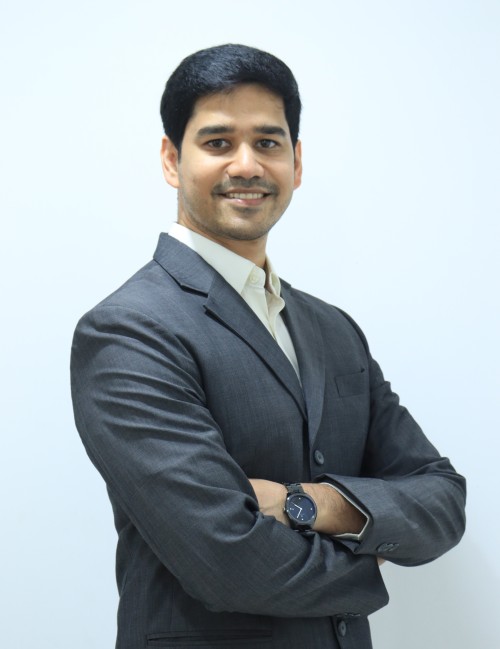
Dr Karthik Gudaru, MS Orthopaedics, MBBS, Fellowship in Knee and Hip Arthroplasty (USA), Fellowship in Computer-Assisted Navigation Joint Replacement Surgery (Germany), is one of Hyderabad’s leading orthopaedic surgeons with an outstanding reputation for precision, innovation, and excellence in joint replacement and orthopaedic care. Widely recognised as the best knee replacement specialist in Hyderabad, he brings a deep commitment to patient-centred care and cutting-edge surgical techniques.
Dr Karthik Gudaru is currently the Senior Orthopaedic and Joint Replacement Specialist, Department of Orthopaedics at GreenMed Hospital, Srinagar Colony, Hyderabad; Assistant Professor and Consultant Orthopaedic at BIRRD Hospital (Balaji Institute of Surgery, Research and Rehabilitation for the Disabled), Tirupati; and Joint Replacement & Pediatric Orthopaedic Specialist at Sri Maruthi Hospitals, Tirupati.
Dr Karthik Gudaru’s treatment specialisations –
- Total Knee Replacement Surgery.
- Total Shoulder Replacement Surgery.
- Hip Joint Treatments
- Total Elbow Arthroscopy.
- Computer-Assisted Knee Replacement Surgery.
- Stem Cell Therapy for key orthopaedic treatments.
- Pediatric Orthopaedics Treatments for Cerebral Palsy, Congenital Anomalies, Poliomyelitis & Metabolic Bone Diseases
- OPD, GreenMed Hospital, 8-3-833/71, Srinagar Colony Main Rd, Kamalapuri Colony, Banjara Hills, Hyderabad, Telangana
- Durgabai Deshmukh Hospital, Vidyanagar, Hyderabad
- Sri Maruthi Hospitals, OPD, 19-3-30/C1, Near RTC Bus Stand, Kennedy Nagar, Tirupati, 517501
- BIRRD Hospital, Tirupati (Consultant & Asst. Professor)
Education and Affiliation
- MBBS: Kasturba Medical College, Manipal University, Karnataka (2012), Registration No: TSMC/FMR/16001
- MS (Orthopaedics): Sri Ramachandra Medical College & Research Institute, Chennai (2016), Registration No: 119525
- Knee & Hip Arthroplasty Fellowship: Dartmouth Hospital, USA (2018)
- Robotic & Computer-Assisted Joint Replacement Fellowship: Asklepios Hospital, Germany (2018)
- AO Trauma & Emergency Orthopaedic Care Fellowship: Guro National Hospital, South Korea (2019–2020)
- Spinal Surgery Observer Training: Yonsei University, South Korea (2015)