

Summary
- Plasma therapy uses the body’s own healing cells to support joint recovery.
- It may help selected patients with arthritis, tendon injuries, or chronic knee pain.
- Proper orthopaedic evaluation is essential before choosing regenerative treatment.
Struggling with chronic knee pain or osteoarthritis? Platelet-Rich Plasma (PRP) therapy offers a regenerative, non-surgical solution to speed up healing. Learn how Dr. Karthik Gudaru uses advanced PRP techniques in Hyderabad to help patients regain mobility and avoid surgery.
This Article is Medically Reviewed by Dr Karthik Gudaru, MS Orthopaedics, Fellowship in Computer-Assisted Navigation and Joint Replacement Surgery (Germany), HOD Orthopaedic Department, GreenMed Hospitals, Hyderabad.
Living with knee pain can quietly affect every part of daily life. Climbing stairs becomes uncomfortable, morning walks feel difficult, and even sitting for long periods may cause stiffness. While many people rely on painkillers or temporary solutions, modern orthopaedic care now offers regenerative treatments that aim to support natural healing. One such option gaining attention is plasma therapy for knee pain, says Dr Karthik Gudaru, Senior Orthopaedic Surgeon for Platelet Rich Plasma Therapy in Hyderabad and in India.
Can Plasma Therapy Really Help Knee Pain?
Plasma therapy, often called PRP therapy, uses the patient’s own blood to support healing in damaged tissues. The blood is processed to concentrate platelets, which contain growth factors believed to assist tissue repair and reduce inflammation.
When injected into the affected knee, these healing factors may help improve pain, mobility, and joint function in carefully selected patients.
“Treating knee pain is not just about reducing discomfort—it is about restoring movement, confidence, and the freedom to live actively again.” – Dr Karthik Gudaru, Sr Orthopedic Surgeon and Specialist in treating Knee Pain with Platelet Rich Plasma Therapy (PRP)
How Does Plasma Therapy Work?
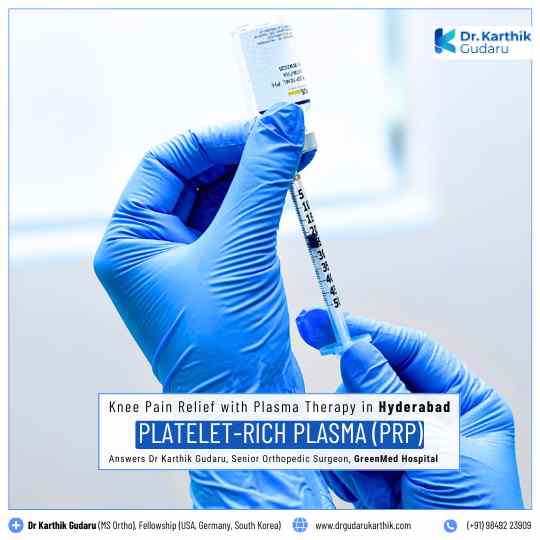
The procedure begins with drawing a small sample of blood. This sample is then processed to separate platelet-rich plasma from other blood components. The concentrated plasma is then injected into the painful or damaged area of the knee under medical guidance.
Because the treatment uses the patient’s own blood, it is considered minimally invasive and is often chosen by people looking for non-surgical treatment options.
Who May Benefit from Plasma Therapy?
Plasma therapy may be considered for patients dealing with early joint degeneration, sports injuries, cartilage wear, tendon inflammation, or chronic knee discomfort that has not improved with medication or physiotherapy.
However, not every knee condition responds the same way. Proper diagnosis, imaging, and orthopedic evaluation are essential before deciding whether PRP is the right treatment.
What Are the Benefits?
One of the biggest advantages of plasma therapy is that it focuses on supporting the body’s natural healing response. Many patients choose it because it may help reduce pain, improve movement, and delay or avoid surgery in suitable cases.
Recovery is usually faster compared with major surgical procedures, though results vary depending on age, joint condition, activity level, and overall health.
Is Plasma Therapy Right for You?
Knee pain is not always caused by the same problem. Ligament strain, cartilage damage, arthritis, and tendon injuries can all create similar symptoms. That is why expert orthopaedic evaluation matters before choosing any treatment. The right diagnosis often determines the right outcome.
When Should You Consult an Orthopaedic Doctor for a Possible Plasma Therapy?
If knee pain continues for weeks, keeps returning after rest, or starts affecting walking, climbing stairs, exercise, or daily movement, it may be time to consult an orthopaedic specialist. Swelling, stiffness, clicking sounds, reduced mobility, or pain during activity can sometimes indicate cartilage damage, tendon injury, early arthritis, or ligament stress.
An orthopaedic evaluation helps identify the real cause of the pain and determine whether treatments like plasma therapy, physiotherapy, medication, or another intervention would be the most effective option. Early diagnosis often leads to better recovery and helps prevent long-term joint damage.

Dr Karthik Gudaru, MS Orthopaedics, MBBS, Fellowship in Knee and Hip Arthroplasty (USA), Fellowship in Computer-Assisted Navigation Joint Replacement Surgery (Germany), is one of Hyderabad’s leading orthopaedic surgeons with an outstanding reputation for precision, innovation, and excellence in joint replacement and orthopaedic care. Widely recognised as the best knee replacement specialist in Hyderabad, he brings a deep commitment to patient-centred care and cutting-edge surgical techniques.
Dr Karthik Gudaru is currently the Senior Orthopaedic and Joint Replacement Specialist, Department of Orthopaedics at GreenMed Hospital, Srinagar Colony, Hyderabad, Assistant Professor and Consultant Orthopaedic at BIRRD Hospital (Balaji Institute of Surgery, Research and Rehabilitation for the Disabled), Tirupati and Joint Replacement & Pediatric Orthopedic Specialist at Sri Maruthi Hospitals, Tirupati.
Dr Karthik Gudaru’s Treatment Specialisation are –
Knee Joint Treatments (Including Total Knee Replacement Surgery).
Shoulder Joint Treatments (Including Total Shoulder Replacement Surgery).
Hip Joint Treatments (Including Total Hip Replacement Surgery).
Elbow Joint Treatments (Including Total Elbow Arthroscopy).
Computer-Assisted Knee Replacement Surgery.
Stem Cell Therapy for key orthopaedic treatments.
Pediatric Orthopedics Surgeon for Cerebral Palsy, Congenital Anomalies, Poliomyelitis & Metabolic Bone Diseases